
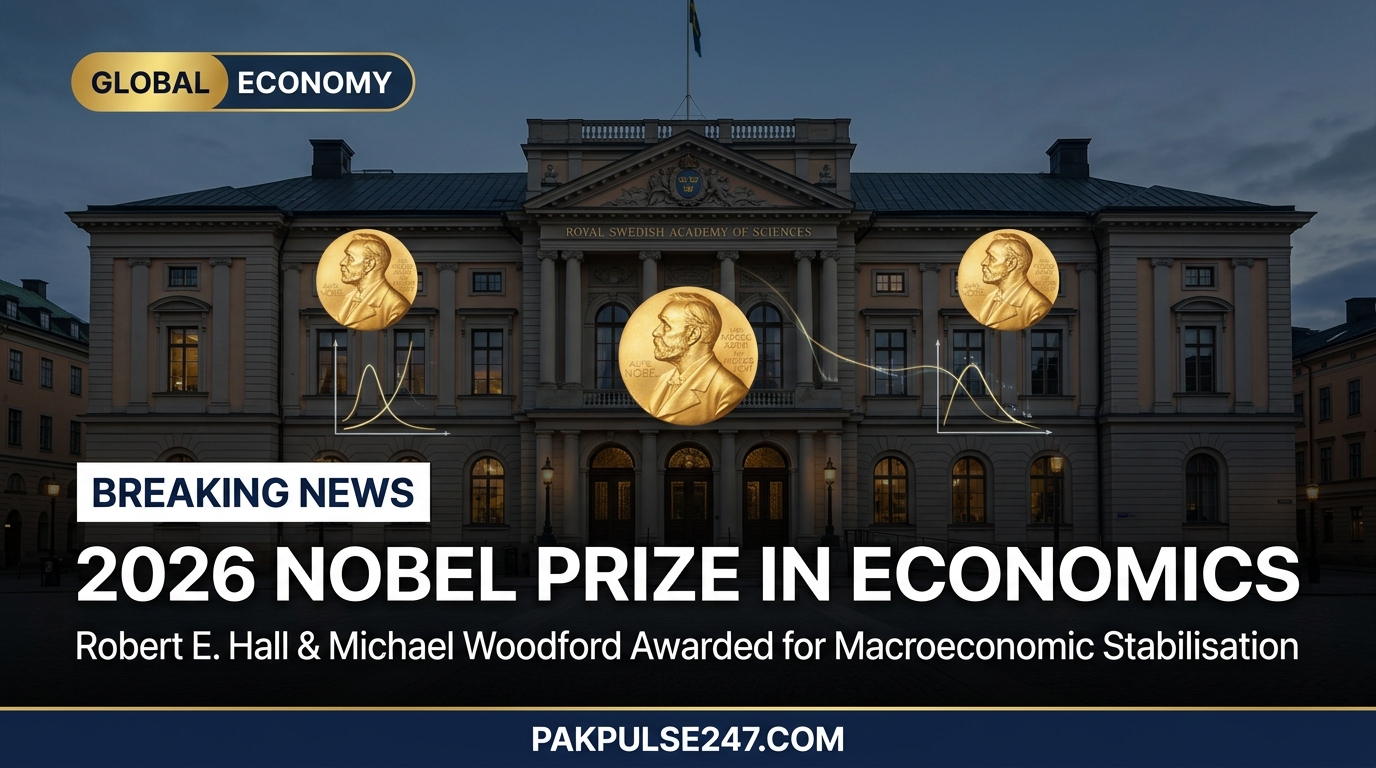
The Royal Swedish Academy of Sciences has awarded the 2026 Sveriges Riksbank Prize in Economic Sciences in Memory of Alfred Nobel to Robert E. Hall of Stanford University and Michael Woodford of Columbia University for their groundbreaking research on the microeconomic foundations of macroeconomic stabilisation.
The prestigious prize, widely known as the Nobel Prize in Economics, carries a monetary award of 11 million Swedish kronor ($1.1 million) to be shared equally between the two American economists. The Academy emphasized that their theoretical breakthroughs transformed modern monetary and fiscal policy frameworks utilized by central banks around the world.
Grounding Macroeconomics in Individual Behavior
Traditional macroeconomic policy throughout the mid-20th century relied heavily on aggregate historical relationships between broad indicators such as gross domestic product, inflation, and employment. Hall and Woodford revolutionized this paradigm by establishing rigorous microeconomic foundations, analyzing how forward-looking households and business enterprises make consumption, pricing, and investment choices.
Robert Hall's seminal research demonstrated that consumer spending is primarily driven by lifetime expected wealth rather than temporary income fluctuations, establishing the permanent-income hypothesis as a foundational pillar of modern economic modeling. His subsequent inquiries into labor market friction provided critical explanations for why unemployment persists during cyclical downturns.
The Architecture of Modern Monetary Policy
Michael Woodford played a central role in constructing what is today known as the New Keynesian macroeconomic framework. In his landmark treatise Interest and Prices, Woodford proved that central banks can effectively anchor price stability and stabilize real economic activity through transparent, rule-based interest rate paths and forward guidance, even in modern financial systems with diminishing cash reserves.
Central banking institutions—including the Federal Reserve, the European Central Bank, and the Bank of England—rely directly on models rooted in Hall and Woodford's formulations to evaluate policy trade-offs, manage inflation shocks, and prevent deep recessions during periods of global financial volatility and international geopolitical crises.
Global Recognition and Future Impact
Speaking following the announcement in Stockholm, representatives of the Nobel Committee noted that the laureates' insights have provided policymakers with practical, mathematically sound instruments to smooth economic volatility and protect household welfare without distorting market incentives.
The award concludes the 2026 Nobel Prize announcement season, following honors in medicine, physics, chemistry, literature, and peace unveiled earlier in the month.