
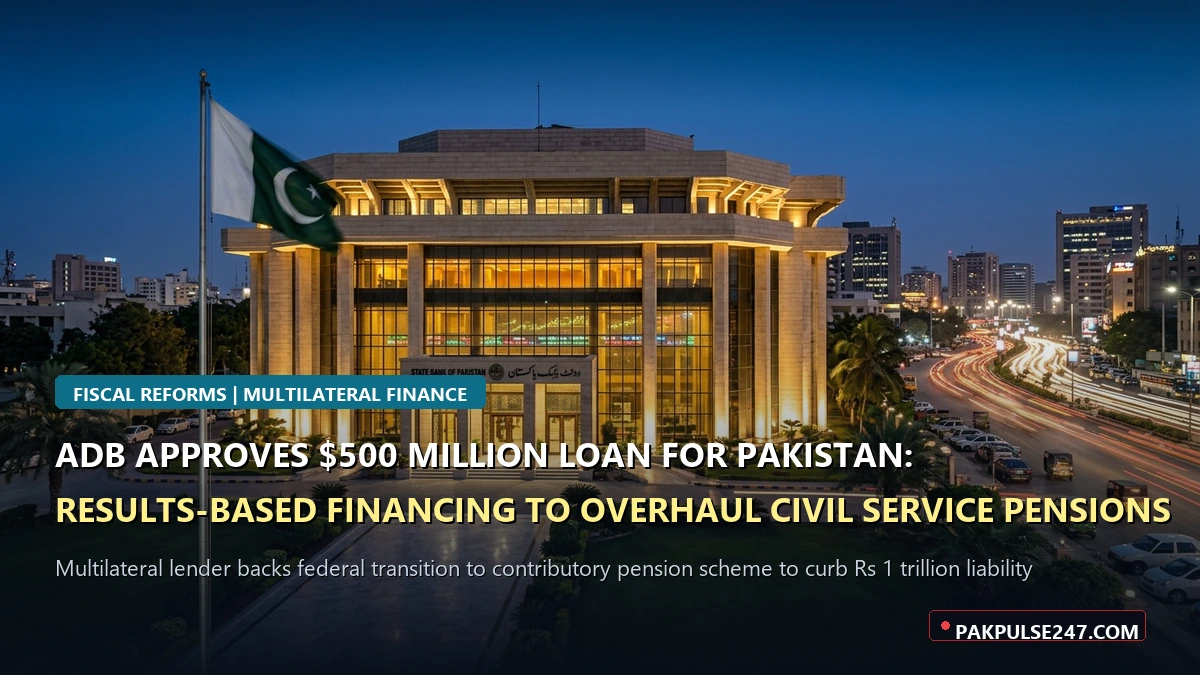
ISLAMABAD: The Asian Development Bank (ADB) has formally approved a landmark $500 million results-based loan to finance the Government of Pakistan’s comprehensive Pension Reform Implementation Plan. The financing initiative is designed to overhaul the country's federal civil pension architecture, transitioning away from an unsustainable legacy defined-benefit model toward a modernized, digitally administered defined contribution pension framework.
Mounting Fiscal Pressure and the Rs 1 Trillion Milestone
Pakistan’s federal pension liabilities have expanded at an alarming pace over the last decade, growing nearly fivefold since fiscal year 2016 to surpass Rs 1 trillion ($3.6 billion) annually. Historically financed entirely through annual budget allocations without a dedicated pre-funded corpus, the runaway pension bill has severely crowded out fiscal room for critical public infrastructure, health, and primary education expenditures.
Institutionalizing the Defined Contribution Model
The newly approved ADB program supports the initial phase of the federal pension roadmap, institutionalizing the mandatory contributory pension scheme introduced for federal civil employees recruited on regular service since July 2024. Under this restructured arrangement, civil servants contribute 10 percent of their pensionable emoluments into individualized retirement accounts, matched by a 12 percent contribution from the federal government. The model aligns Pakistan’s civil administration with contemporary global standards and eliminates unfunded long-term state liabilities.
Digital Governance, Actuarial Audits, and Fiscal Space
According to project documentation released by the ADB, the loan incorporates stringent disbursement-linked indicators (DLIs) centered on institutional capacity building, automated biometric verification to eliminate ghost beneficiaries, and mandatory periodic actuarial valuations of state balance sheets. Multilateral economists project that the structural overhaul will steadily compress long-term government debt obligations and support Pakistan's broader macroeconomic consolidation agenda agreed with international financial partners.
Reactions from Financial Markets and Policymakers
Senior officials from the Ministry of Finance welcomed the board's decision, describing the $500 million influx as vital external budget support that bolsters official foreign exchange reserves while accelerating systemic administrative modernizations. For continuous updates on fiscal policy, macroeconomic indicators, and multilateral funding, visit the Pak Pulse 247 News Desk.