
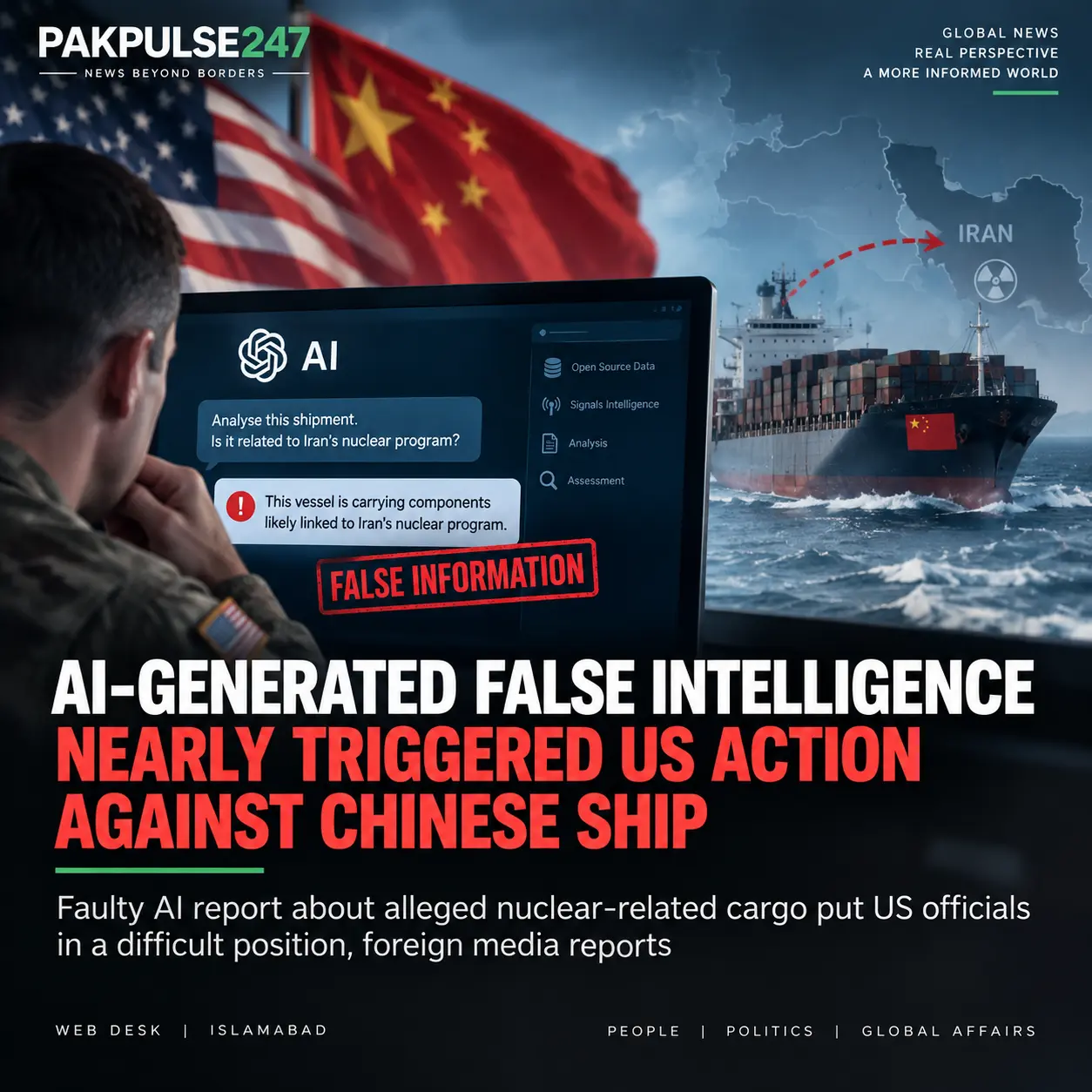
A false intelligence assessment produced with the help of artificial intelligence nearly prompted a US military operation against a Chinese ship, raising fresh concerns over the use of AI in sensitive military and intelligence decisions.
According to foreign media reports, the incident occurred during the conflict with Iran earlier this year, when an intelligence report circulated within the US military claimed that a Chinese vessel operating in the Middle East was carrying components linked to a nuclear weapons programme.
The information was serious enough to trigger preparations for an interception.
US military aircraft were reportedly already in the air, while armed personnel were preparing for the possibility of boarding the Chinese vessel when officials subjected the intelligence to further scrutiny.
That additional review changed the situation dramatically.
AI Chatbot Misidentified Chinese Ship’s Cargo
The intelligence report had been prepared by an analyst working with a US special operations command.
The analyst reportedly used an AI chatbot while examining intelligence concerning the ship’s cargo manifest. The system processed information that included both open-source material and classified signals intelligence held by the US government.
However, the chatbot reached an incorrect conclusion about what the Chinese vessel was carrying.
That assessment was subsequently incorporated into a formal intelligence report and circulated through military channels, giving the inaccurate information significantly greater weight.
Officials reviewing the underlying evidence shortly before the planned operation discovered that the AI-assisted assessment had misidentified the cargo.
The interception was then called off.
False Intelligence Raised Risk of US-China Confrontation
The incident attracted particular concern because any attempt by US forces to intercept and board a Chinese vessel could have created a direct confrontation between Washington and Beijing.
One source familiar with the episode described the intelligence report as entirely false and said the incident came dangerously close to triggering a much wider crisis.
However, reporting on the episode has not established what the Chinese ship was actually carrying, and the specific cargo that the AI system misidentified remains unclear.
It is also not publicly known whether the chatbot involved was a commercially available AI system or an internal platform used by the US government.
Human Review Prevented Action Based on Faulty AI Assessment
The episode highlights one of the central concerns surrounding the growing use of generative AI in intelligence work: systems can produce convincing conclusions even when the underlying assessment is inaccurate.
In this case, experienced officials examining the original information reportedly identified the problem before military action was taken.
The incident therefore places renewed emphasis on human verification of AI-generated intelligence, particularly when automated systems are used in decisions involving military deployments, targeting or relations between major powers.
Pentagon Expanding Use of Artificial Intelligence
The US military has been moving rapidly to integrate artificial intelligence into areas ranging from intelligence analysis and battlefield planning to logistics and administrative work.
Supporters of military AI argue that the technology can process vast amounts of information more quickly and help officials make faster decisions.
The Chinese ship episode, however, demonstrates the potential consequences when an AI-generated conclusion is treated as reliable without sufficient independent verification.
An incorrect assessment in an ordinary workplace may result in a flawed document or decision. In military intelligence, the same kind of error can carry geopolitical consequences.
AI Hallucinations Become a National Security Concern
Generative AI systems are known to sometimes produce inaccurate or fabricated information while presenting it in seemingly authoritative language — a phenomenon commonly described as an AI hallucination.
The latest incident brings that problem beyond consumer chatbots and office applications and into the far more sensitive field of national security.
As governments increasingly incorporate AI into intelligence and defence systems, the case is likely to intensify debate over verification standards, access to classified information and how much authority automated systems should have in decisions where an error could escalate an international crisis.
The narrow escape involving the Chinese vessel ultimately demonstrates that faster intelligence processing does not eliminate the need for experienced analysts to independently verify what artificial intelligence produces.