
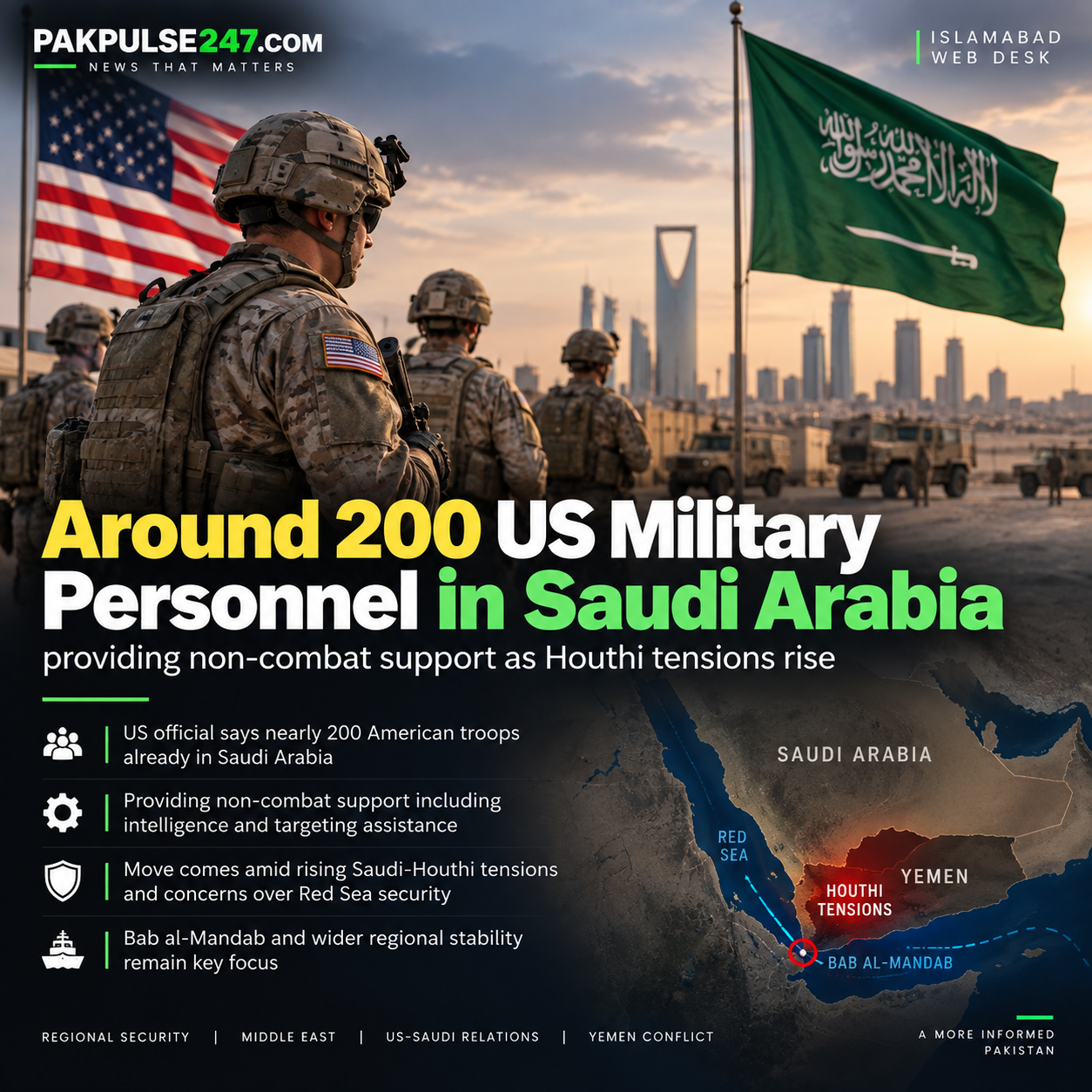
Around 200 US military personnel are currently in Saudi Arabia, providing non-combat and non-kinetic assistance as Riyadh faces an increasingly tense confrontation with Yemen’s Houthi movement, according to a US official familiar with the situation.
The American personnel are not reported to be directly carrying out attacks. Their role is understood to include intelligence coordination, targeting assistance and other forms of military support that stop short of direct participation in combat operations.
The development comes at a sensitive moment for the Middle East as fighting involving Saudi Arabia and the Iran-backed Houthis raises fresh concerns about the security of the Red Sea and Bab al-Mandab Strait, one of the world’s most important maritime trade routes.
US Steps Up Support for Saudi Arabia
Washington has increased coordination with Saudi Arabia as the security situation around Yemen deteriorates.
US Central Command chief Admiral Brad Cooper has also travelled to Saudi Arabia for high-level coordination talks as American and Saudi officials assess the rapidly changing situation in Yemen and the Red Sea.
The presence of roughly 200 American military personnel highlights the growing level of cooperation between Washington and Riyadh, even as the Trump administration seeks to avoid opening another direct military front in the Middle East.
US officials have indicated that their immediate approach is to strengthen Saudi defensive capabilities while keeping American forces focused on broader regional priorities.
US Personnel Not Directly Involved in Strikes
The distinction between combat and support roles has become particularly important as tensions rise.
The American personnel are reportedly providing what officials describe as non-kinetic support, meaning they are not themselves conducting airstrikes or other direct attacks.
Their assistance can include intelligence sharing, operational coordination and information that helps Saudi forces assess potential threats.
Washington is also expected to provide intelligence and targeting information related to Houthi positions as part of its expanding security cooperation with Saudi Arabia.
For now, however, there is no indication that the United States intends to directly join Saudi military operations against the Houthis.
Trump Reportedly Avoids Opening Another Front
The latest developments come as Saudi Arabia faces renewed pressure from Houthi missile and drone attacks.
Saudi Crown Prince Mohammed bin Salman has discussed the deteriorating security situation with US President Donald Trump as the Houthi movement expands its operations near strategically important areas of Yemen.
Despite growing Saudi concerns, the Trump administration has so far appeared reluctant to launch a new direct US campaign against the Houthis.
Washington is already heavily engaged in the continuing confrontation with Iran and in efforts to protect shipping around the Strait of Hormuz.
Opening another major military front in Yemen could further stretch American forces operating across the region.
Bab al-Mandab Becomes Key Concern
The Bab al-Mandab Strait has emerged as one of the biggest concerns in the latest escalation.
The narrow waterway connects the Red Sea with the Gulf of Aden and serves as a vital route for international shipping, energy supplies and commercial traffic moving between Asia, the Middle East and Europe.
Any prolonged disruption could affect global shipping costs and international oil markets.
The situation has become more serious as Houthi forces expand their influence close to the Red Sea coast, raising fears that pressure on shipping could increase.
At the same time, instability around the Strait of Hormuz has already created uncertainty for Gulf energy exports.
The possibility of disruptions affecting both major maritime routes has therefore increased international concern over the conflict.
Saudi-Houthi Tensions Raise Regional Risks
Saudi Arabia has faced missile and drone attacks linked to the Houthis while Saudi forces and their Yemeni allies have responded with military operations.
The escalation is taking place against the backdrop of the broader confrontation involving the United States and Iran.
Tehran has long maintained close ties with the Houthi movement, although Iran has rejected claims that it directly controls Houthi military decisions.
The deployment of American military personnel in a support role indicates that Washington is prepared to assist Saudi Arabia while, at least for now, trying to avoid direct involvement in another regional war.
With Saudi-Houthi tensions rising and strategic shipping routes increasingly exposed, the role of the approximately 200 US personnel inside Saudi Arabia is likely to remain closely watched as the regional security situation develops.