
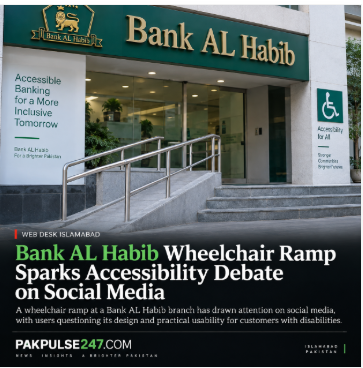
A wheelchair ramp installed at a Bank AL Habib branch has attracted attention on social media, with users questioning its design and practical usability for customers with disabilities.
A widely circulated image appears to show a ramp leading towards the entrance of the bank branch. However, its apparent steepness and design have prompted social media users to question whether a person using a wheelchair could safely and independently use the facility.
The discussion has quickly turned into a broader debate about accessibility standards in Pakistan, with users pointing out that simply constructing a ramp does not necessarily make a building accessible.
Some social media users responded with satire, suggesting that bank staff, including the branch manager, should try using the ramp while seated in a wheelchair to understand whether the facility actually serves its intended purpose.
Accessibility Is More Than Just Building a Ramp
For wheelchair users and people with mobility challenges, accessible entrances are an important part of financial inclusion.
A properly designed accessibility facility should allow customers to enter and leave a bank branch safely and, wherever possible, without unnecessary dependence on others.
The usability of a wheelchair ramp depends on several factors, including its gradient, width, surface, handrails and safe connection with the building entrance. A ramp that is excessively steep or difficult to navigate can turn what is intended as a facility into another obstacle.
Social Media Satire Raises a Serious Question
While much of the reaction to the Bank AL Habib ramp has been humorous and sarcastic, the discussion raises a serious question about accessibility infrastructure across Pakistan.
Are ramps and similar facilities being designed around the actual needs of people with disabilities, or are they sometimes being installed merely to meet formal requirements?
The viral discussion highlights the importance of evaluating accessibility from the perspective of the people who actually use these facilities.
The exact branch shown in the circulating material and the circumstances surrounding the construction of the ramp could not be independently established from the available information. No specific response regarding the viral ramp was available from the branch at the time of writing.
However, the discussion has once again brought attention to a wider issue: accessibility should not simply mean the presence of a ramp — it should mean providing a safe, practical and genuinely usable route for people with disabilities.