
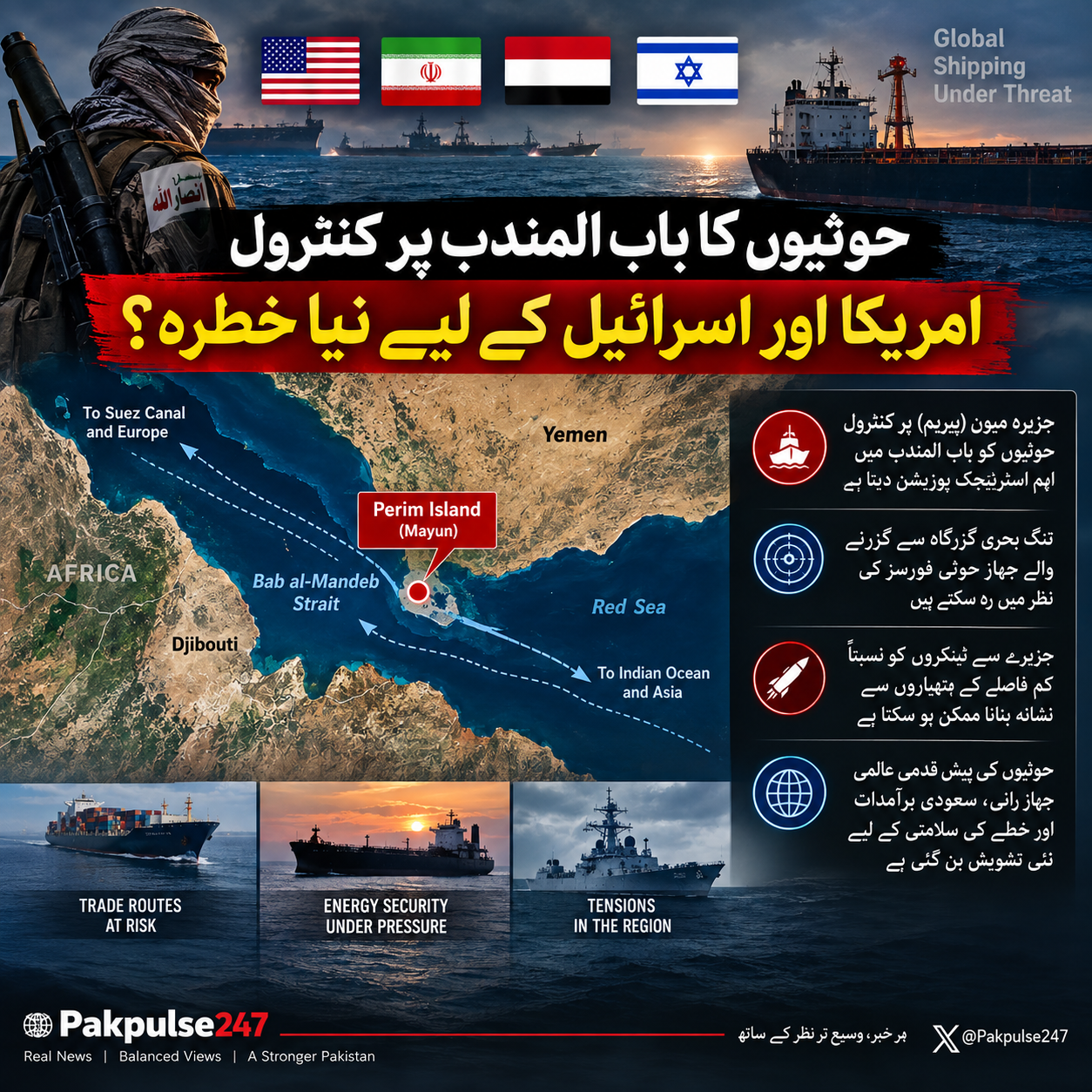
A dramatic shift in Yemen has placed the Bab al-Mandeb Strait at the centre of the Middle East’s widening geopolitical confrontation, after Houthi forces took control of the strategically located Perim Island, also known as Mayun, near one of the world’s most important maritime routes.
The development has triggered a new debate over whether Bab al-Mandeb could now become an even more immediate threat to regional shipping than the Strait of Hormuz, where tensions between Iran, the United States and Israel have already disrupted energy flows.
The comparison is not simply about which strait carries more oil. Geography, military positioning and the availability of alternative shipping routes all make Bab al-Mandeb particularly sensitive.
Why Perim Island matters
Perim Island sits inside the Bab al-Mandeb Strait between Yemen and the Horn of Africa, effectively dividing the passage into two channels.
Its location gives whoever controls the island an important position overlooking vessels entering or leaving the Red Sea.
The narrower eastern passage lies between the island and the Yemeni mainland, while the much wider western channel carries a major share of commercial shipping.
This does not mean the Houthis can automatically stop every vessel travelling through Bab al-Mandeb. Modern maritime control requires surveillance, missiles, drones, targeting systems and sustained military operations.
However, control of Perim significantly improves the group's geographical position.
From the island and nearby Yemeni coastline, forces can monitor shipping movements more closely and potentially deploy weapons much nearer to passing maritime traffic.
Bab al-Mandeb becomes more important as Hormuz remains under pressure
The timing of the Houthi advance is particularly significant.
The Strait of Hormuz has traditionally been the world's most important oil chokepoint, but continuing conflict involving Iran has sharply reduced normal shipping activity through the passage.
That disruption pushed Saudi Arabia and other producers to rely more heavily on alternative routes, including Saudi Arabia's East-West pipeline, which moves crude toward the Red Sea coast.
From there, tankers still depend on the Red Sea and Bab al-Mandeb to reach many Asian markets.
That means a route being used partly to reduce dependence on Hormuz is itself becoming exposed to another security threat.
Recent energy-flow figures underline the shift. Oil and petroleum-product traffic through Bab al-Mandeb rose sharply during 2026 as volumes through Hormuz fell.
This is why the latest Houthi territorial gains have attracted attention well beyond Yemen.
Is Bab al-Mandeb now more dangerous than Hormuz?
Calling Bab al-Mandeb definitively "more dangerous" than Hormuz would be an oversimplification.
Iran possesses a far larger conventional military capability around Hormuz, including coastal missile systems, naval units, drones and surveillance infrastructure.
But Bab al-Mandeb presents a different kind of challenge.
The waterway is narrow, shipping is concentrated into predictable corridors, and the Houthis have already demonstrated their ability to use missiles and drones against commercial vessels in and around the Red Sea.
Control of additional coastline and Perim Island could shorten the distance between Houthi weapons and maritime targets.
That increases the pressure on commercial operators, even without a formal closure of the strait.
For shipping companies, the calculation is not limited to whether a vessel will actually be attacked. Insurance premiums, crew safety, naval escorts and the possibility of rerouting around Africa can all affect the cost of moving goods.
Red Sea experience already worries Washington and Israel
The United States and Israel have dealt with the consequences of Houthi attacks on Red Sea traffic before.
Previous attacks forced many major shipping companies to avoid the Red Sea and divert vessels around the Cape of Good Hope, adding significant distance, time and cost to voyages between Asia and Europe.
The latest Houthi advance therefore changes more than the map of Yemen.
It gives the group stronger physical access to a maritime chokepoint it has already shown a willingness to pressure.
For Washington, keeping Bab al-Mandeb open is important not only for energy markets but also for maintaining uninterrupted trade between the Indian Ocean, Red Sea, Suez Canal and Mediterranean.
For Israel, disruption in the southern Red Sea can also place pressure on shipping connected to the Israeli port of Eilat and broader regional supply routes.
Saudi Arabia faces a second strategic problem
Saudi Arabia may have the most immediate reason for concern.
Restrictions around Hormuz had increased the importance of Saudi Arabia's western export infrastructure and the port of Yanbu.
But oil leaving the Red Sea toward Asian markets ultimately has to travel south through Bab al-Mandeb.
A serious interruption there could therefore weaken one of Riyadh's most important alternatives to Hormuz.
Even without a complete blockade, persistent threats to tankers could increase transport costs and reduce confidence in the route.
A new pressure point in the wider regional conflict
The seizure of Perim Island does not mean international shipping through Bab al-Mandeb has stopped.
Nor does it establish that the Houthis can maintain complete control over the strait indefinitely.
The Yemeni conflict remains fluid, and forces opposing the Houthis could attempt to retake strategic coastal positions and islands.
But the latest battlefield changes have created a new reality: the conflict around Iran, Saudi Arabia, the United States and Israel now has two major maritime pressure points — Hormuz in the Gulf and Bab al-Mandeb at the entrance to the Red Sea.
If instability around both routes continues simultaneously, the consequences could extend far beyond the Middle East, affecting oil prices, shipping costs, insurance rates and trade between Asia and Europe.
For global markets, Bab al-Mandeb is no longer a secondary concern. It has become one of the most closely watched pieces of geography in the widening regional crisis. (Reuters)