
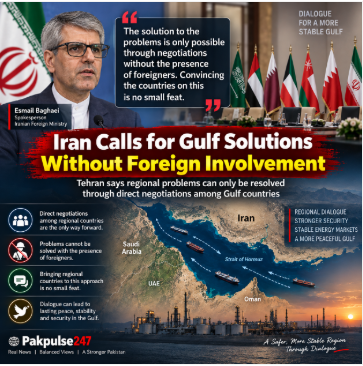
Iran has renewed its call for Gulf countries to resolve regional disputes through direct negotiations without the involvement of outside powers, as Tehran and its Arab neighbours prepare for a crucial meeting in Oman focused on the Strait of Hormuz and the future of Gulf security.
Speaking to Iranian state television, Foreign Ministry spokesperson Esmail Baghaei said lasting solutions to the region’s problems could only emerge through dialogue among the countries directly involved.
He argued that persuading regional states to move toward such a framework was itself a significant diplomatic achievement, particularly at a time when the Gulf remains caught between military confrontation, disrupted energy routes and the presence of major foreign forces.
The comments come ahead of a meeting expected to bring together Iran, Iraq and Gulf Arab states in Oman, with maritime security and commercial navigation through the Strait of Hormuz high on the agenda.
Iran Wants Regional Countries to Take the Lead
Tehran’s latest message reflects a long-standing Iranian argument that Gulf security should be managed primarily by the countries of the region rather than by military powers from outside the Middle East.
Baghaei’s remarks, however, come at an unusually sensitive moment.
The continuing Iran-US confrontation, instability around the Strait of Hormuz and renewed fighting involving Yemen’s Houthis have placed Gulf governments under growing pressure to find ways of preventing the crisis from expanding further.
For Iran, direct engagement with Saudi Arabia, Qatar, the United Arab Emirates, Oman, Kuwait, Bahrain and Iraq offers an opportunity to push the idea of a regional security arrangement in which Washington plays a reduced role.
For Gulf countries, the calculation is more complicated.
Many maintain extensive defence partnerships with the United States while also recognising that a prolonged confrontation with Iran could directly threaten their cities, energy infrastructure and commercial shipping.
Strait of Hormuz at Centre of Talks
The most immediate issue is the Strait of Hormuz.
The narrow waterway remains one of the world's most important energy routes and has been severely disrupted during the latest phase of the regional conflict.
Iran and Oman have already been holding discussions on arrangements for safer commercial navigation through the strait.
The upcoming regional meeting is expected to broaden those discussions by bringing other Gulf states into the process.
Tehran says it remains committed to maritime security but insists that arrangements governing the waterway must respect the sovereignty and security interests of countries bordering it.
This has created a much wider debate over who should ultimately guarantee freedom of navigation through the Gulf.
Why the Gulf States Are Listening
Iran’s call for regional dialogue is not being made in a political vacuum.
Recent months have demonstrated how quickly conflict involving Iran can spread across national borders.
Military bases, oil infrastructure, shipping routes and commercial vessels have all become part of the broader security equation.
At the same time, renewed Houthi operations in Yemen have placed additional pressure on Saudi Arabia and the Bab al-Mandeb shipping route.
The result is an increasingly difficult situation for Gulf governments.
Relying heavily on outside military protection carries its own risks when foreign forces are themselves involved in the confrontation.
But moving toward a regional arrangement with Iran would require a level of trust that has historically been difficult to achieve.
Baghaei’s comment that bringing countries toward negotiations is “no small feat” appears to acknowledge precisely that challenge.
Foreign Military Presence Remains the Major Divide
One of the biggest obstacles to Iran’s vision is the extensive foreign military presence across the Gulf.
The United States maintains major military facilities and defence relationships throughout the region.
Several Gulf countries view those partnerships as an important part of their national security architecture.
Iran, by contrast, has repeatedly argued that the presence of foreign forces increases rather than reduces instability.
Tehran therefore appears to be using the current crisis to make a broader strategic case: regional states should talk directly to each other instead of relying on external powers to manage their security disputes.
Whether Gulf governments are prepared to move substantially in that direction remains uncertain.
Saudi-Iran Relationship Could Be Critical
Saudi Arabia will be particularly important to any future regional security structure.
Riyadh is simultaneously dealing with Houthi pressure from Yemen, threats to energy infrastructure and disruption of key maritime routes.
A direct Saudi-Iranian understanding could significantly reduce the risk of a wider Gulf confrontation.
But the relationship remains complicated by Yemen and Tehran’s ties with armed groups across the region.
This means diplomatic dialogue may advance even while serious security disagreements remain unresolved.
The key test will be whether talks produce practical mechanisms to protect shipping and infrastructure rather than simply another series of political statements.
Oman Again Emerges as a Diplomatic Centre
Oman’s role is also becoming increasingly significant.
Muscat has maintained channels with both Iran and Western governments and has frequently positioned itself as a diplomatic bridge during regional crises.
Its location on the Strait of Hormuz gives it an additional strategic interest in establishing a workable maritime arrangement.
Holding the Gulf meeting in Oman therefore gives the talks both diplomatic and geographical importance.
Discussions are likely to focus not only on political relations but also on the practical question of how commercial ships can move safely through one of the world's most sensitive waterways.
A Different Security Order for the Gulf?
Baghaei’s remarks raise a larger question beyond the immediate Hormuz crisis.
The Gulf security system has for decades relied heavily on American military power and bilateral defence relationships.
Iran is now arguing for a different model based on regional dialogue and reduced foreign involvement.
The current instability may give that argument more attention than it received in the past, but convincing Gulf governments to fundamentally change their security partnerships would be far more difficult than arranging a diplomatic meeting.
For now, the more realistic objective is narrower: prevent further escalation, keep commercial shipping moving and establish direct communication between Iran and neighbouring Gulf states.
If the Oman meeting produces even limited agreement on those issues, it could represent an important diplomatic shift at a time when military confrontation has placed both the Strait of Hormuz and the wider Gulf economy under intense pressure.
The central question is whether regional countries can turn dialogue into a functioning security mechanism — or whether the Gulf will remain dependent on external powers while simultaneously trying to manage an increasingly dangerous confrontation with Iran.