
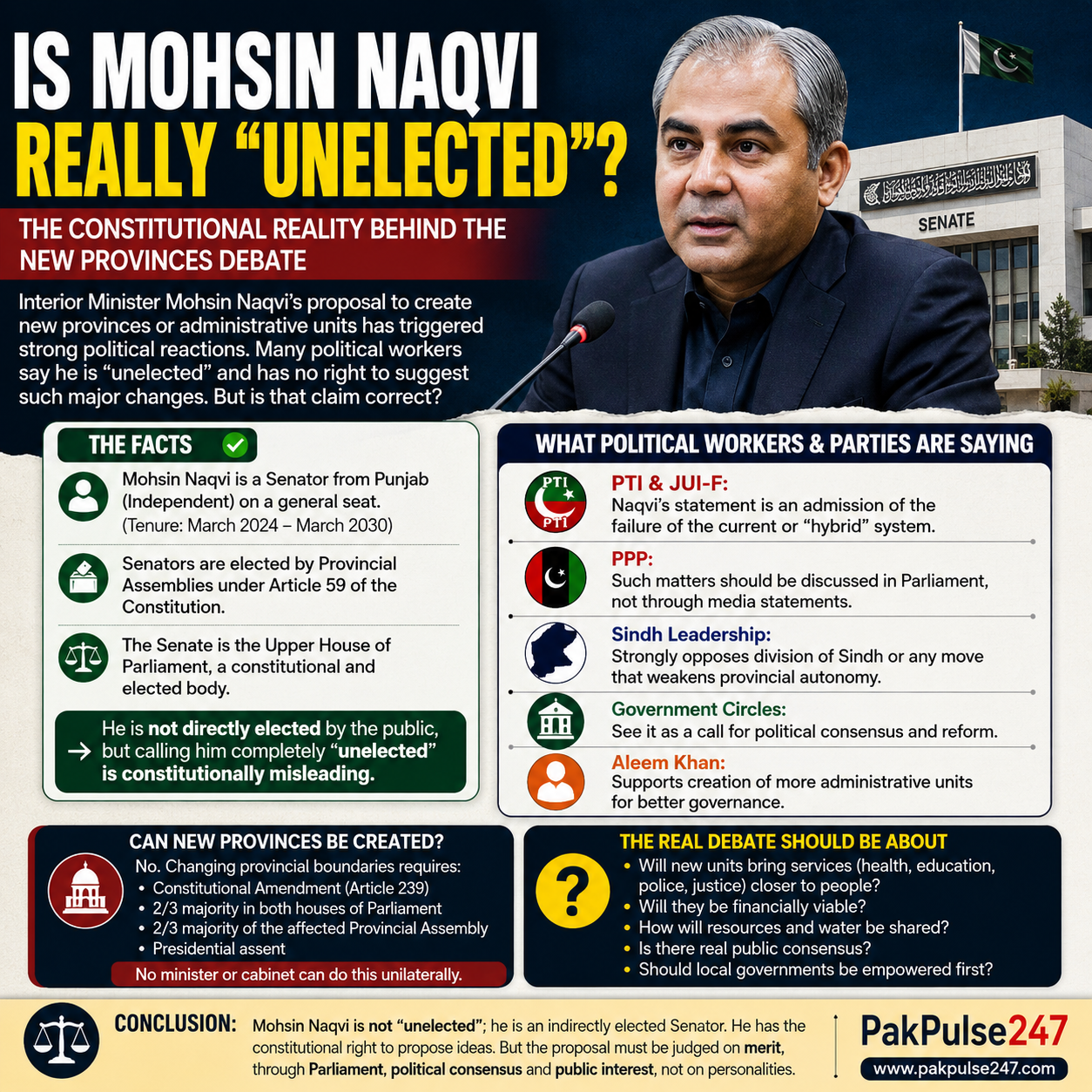
Is Mohsin Naqvi Really “Unelected”? The Constitutional Reality Behind Pakistan’s New Provinces Debate
Interior Minister Mohsin Naqvi’s call for new provinces or smaller administrative units has reopened a politically sensitive debate in Pakistan. While some people support the proposal as a possible solution to weak governance and poor public-service delivery, many political workers have focused their criticism on Naqvi himself.
A common reaction on social media has been: how can an “unelected person” propose such major changes to Pakistan’s political and administrative structure?
The criticism raises a legitimate question about democratic accountability. However, describing Mohsin Naqvi as entirely “unelected” ignores an important constitutional distinction between a directly elected representative and an indirectly elected member of Parliament.
What Did Mohsin Naqvi Propose?
Speaking at the Pakistan Economic Summit 2026 in Islamabad on July 30, Mohsin Naqvi argued that Pakistan’s existing governance system had “collapsed” and was no longer capable of adequately addressing the country’s challenges.
He called on political parties to reach a consensus on structural reforms, including the creation of new provinces or administrative units. Naqvi said the proposed units could be called provinces or given another designation, but the issue should ultimately be taken to the public.
His central argument was that smaller administrative units could bring government closer to citizens, create new political leadership and improve the delivery of essential services. He did not announce a formal plan, proposed map or constitutional amendment. Instead, his remarks amounted to a call for political discussion and consensus.
Why Are People Calling Him Unelected?
Much of the criticism originates from the fact that Mohsin Naqvi has never won a National Assembly or provincial assembly constituency through a direct public vote.
Before joining the federal government, he served as the caretaker chief minister of Punjab. That position was based on appointment rather than a general election. His subsequent appointment as interior minister also generated political criticism, particularly from opposition supporters who questioned his direct connection with voters.
This background has shaped the political perception that Naqvi does not possess an independent public mandate comparable to that of a member of the National Assembly elected from a geographical constituency.
That criticism can be made as a political argument. However, it should not be confused with his current legal and parliamentary status.
Mohsin Naqvi Is an Elected Senator
According to the official website of the Senate of Pakistan, Syed Mohsin Raza Naqvi represents Punjab as an independent senator on a general seat. His tenure runs from March 2024 to March 2030, and he took oath as a senator on April 9, 2024.
Pakistan’s senators are not normally elected through a direct vote of the general public. Under Article 59 of the Constitution, members of the Senate representing a province are elected by the members of that province’s assembly.
The Senate’s own explanation of its election process confirms that provincial assemblies elect senators from their respective provinces.
Therefore, Mohsin Naqvi is not directly elected by the public, but he is indirectly elected through Pakistan’s constitutional parliamentary system.
Calling him “not directly elected” is factually accurate. Calling him completely “unelected” is technically misleading because it disregards his election to the upper house of Parliament.
Direct and Indirect Elections Are Both Part of Democracy
Pakistan has a bicameral Parliament consisting of the National Assembly and the Senate.
Members of the National Assembly are generally chosen by voters from territorial constituencies. Senators, by contrast, are elected indirectly through provincial assemblies. This system is designed to provide representation to the federating units and prevent larger provinces from dominating Parliament solely because of their population.
A senator does not require a National Assembly constituency to participate in national legislation, debate constitutional reforms or serve as a federal minister. The Senate is not an advisory body outside Parliament; it is the constitutional upper house of Parliament.
Therefore, the claim that a senator has no right to discuss national governance simply because he was not directly elected by the public is difficult to defend constitutionally.
The more credible criticism would be that an indirectly elected senator may not possess the same type of constituency-based mandate as a directly elected member of the National Assembly. That is a debate about the strength and nature of political legitimacy—not about whether the person legally holds elected office.
Political Legitimacy Can Still Be Questioned
Correcting the terminology does not mean that Mohsin Naqvi is beyond political criticism.
Political workers can still question how he secured support in the Punjab Assembly, which parties supported his Senate candidacy and whether his political influence reflects popular approval or elite consensus.
They can also ask why a minister who is part of the existing federal system is publicly declaring that the system has collapsed. Similarly, critics may question whether the government should first improve local governments, municipal institutions and district administrations before proposing additional provincial structures.
These are legitimate questions of accountability, governance and political mandate.
The distinction is simple: Naqvi’s political legitimacy can be debated, but his constitutional position as an elected senator cannot simply be erased from the discussion.
How Have Political Parties Responded?
The Pakistan Peoples Party expressed caution over reopening the issue. PPP Vice President Senator Sherry Rehman said no concrete proposal had been shared with political stakeholders and argued that the debate should not be taken further without proper consultation and a clear framework.
She maintained that governance reforms should be pursued through political dialogue and democratic consensus.
Minister of State for Interior Tallal Chaudhry defended Naqvi’s remarks, saying they were made in good faith and should be viewed as an invitation to political parties to discuss governance reforms rather than an attempt to undermine the constitutional system.
He argued that new provinces could be considered where poor governance and weak service delivery justified administrative restructuring.
The broader political debate also reflects longstanding regional differences. The MQM-P has supported the creation of additional provinces or administrative units, including a separate status for Karachi, while the PPP has strongly resisted any division of Sindh. At different times, both the PPP and PTI have supported the creation of a separate South Punjab province.
This history shows that political parties often support or oppose new provinces according to regional interests, electoral calculations and the specific province being discussed.
Can Mohsin Naqvi Create New Provinces?
No federal minister, senator, prime minister or cabinet can unilaterally create a new province.
Creating a province by altering the boundaries of an existing province requires a constitutional amendment. Under Article 239, a constitutional amendment must secure at least a two-thirds majority of the total membership of both houses of Parliament.
Where an amendment would alter the boundaries of a province, it must also be passed by at least two-thirds of the total membership of the assembly of the affected province before it can receive presidential assent.
This means Mohsin Naqvi’s statement is a political proposal, not an executive decision.
Any practical move towards new provinces would require a formal plan, parliamentary legislation, provincial approval and a broad political consensus. Public consultation or a referendum could become part of the political process, but public consultation alone would not replace the constitutional requirements.
Would New Provinces Improve Governance?
Supporters believe Pakistan’s existing provinces are too large in population and administrative reach. They argue that smaller units could make chief ministers, provincial departments and public institutions more accessible to ordinary citizens.
New administrative centres could also reduce the concentration of resources in provincial capitals and improve local decision-making in neglected regions.
Critics respond that creating more provinces would also mean additional assemblies, cabinets, governors, chief ministers, departments and bureaucratic expenditure. Without genuine fiscal decentralisation, the new units could reproduce the same centralised governance model on a smaller scale.
There is also a strong argument that Pakistan should first implement empowered local governments. If districts, cities and union councils receive meaningful financial and administrative authority, many service-delivery problems could potentially be addressed without immediately redrawing provincial boundaries.
Therefore, the debate should not be reduced to a choice between supporting or opposing Mohsin Naqvi. The proposal should be evaluated against measurable questions:
Would new units improve health, education, policing and municipal services?
Would they be financially sustainable?
How would water, natural resources, government employment and federal revenues be distributed?
Would the boundaries be based on administrative efficiency, population, geography, language or political identity?
Most importantly, would the affected population support the proposed arrangement?
The Real Contradiction in the Debate
There is an obvious contradiction when political activists recognise the Senate as a legitimate house of Parliament but describe one of its sitting members as entirely unelected.
A senator may not have a direct constituency-based mandate, but the office is filled through an election conducted within the constitutional framework. Rejecting a senator’s elected status would effectively mean rejecting the indirect election system through which the entire upper house is formed.
At the same time, being a senator should not shield Naqvi from scrutiny. His political background, the coalition support behind his Senate election and his role in the current government remain open to criticism.
The more accurate position is therefore balanced:
Mohsin Naqvi is an indirectly elected senator, not a directly elected public representative. He has the constitutional standing to raise proposals about governance and administrative reform. However, his proposal does not become correct merely because he holds office, and it cannot be implemented without Parliament, the concerned provincial assemblies and meaningful public consent.
Conclusion
The controversy surrounding Mohsin Naqvi’s statement illustrates how political debate often becomes focused on personalities rather than proposals.
Political workers are entitled to question his public mandate, performance and influence within the government. However, accuracy matters. Calling him “unelected” without acknowledging his position as a senator creates a misleading impression.
The stronger argument is not that Mohsin Naqvi has no right to speak. The stronger argument is that any proposal for new provinces must be supported by evidence, constitutional procedure, financial planning, provincial consent and public participation.
Pakistan’s administrative structure deserves serious discussion. That discussion should neither be dismissed because of the identity of the person who initiated it nor accepted without scrutiny because it came from a federal minister.
The proposal must ultimately be judged on whether it transfers meaningful power and services to citizens—or merely creates another layer of political and bureaucratic authority.