
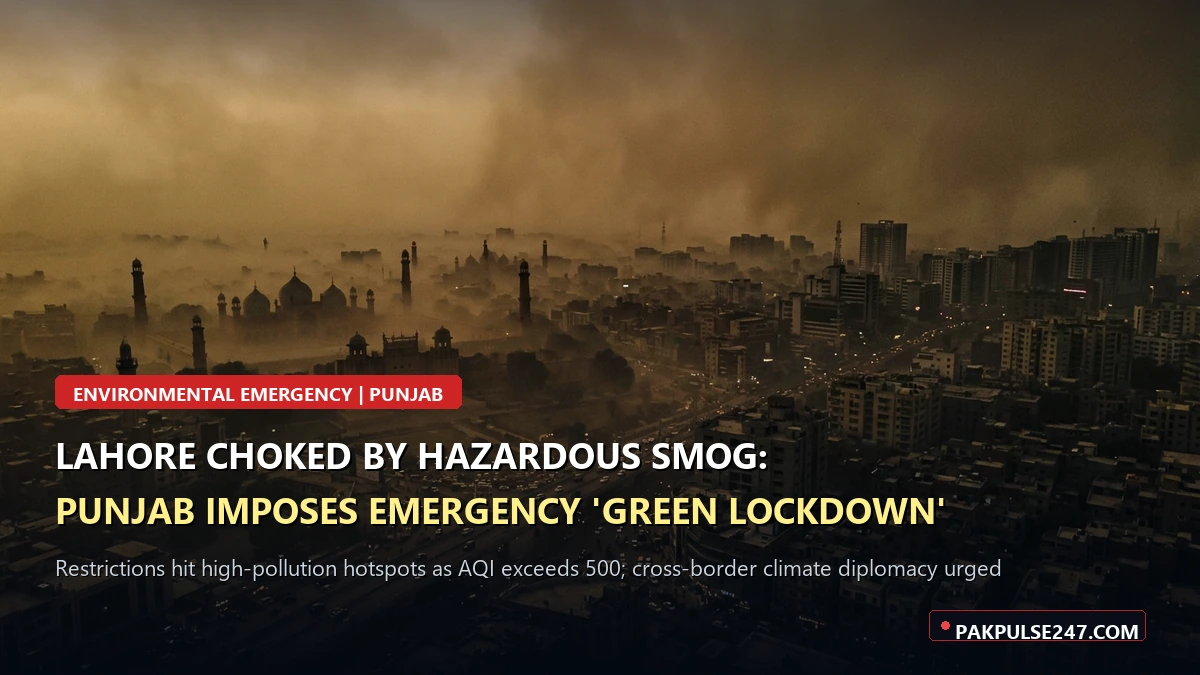
LAHORE — In an urgent public health intervention to confront hazardous air pollution, the Punjab government has declared an emergency "green lockdown" across multiple designated environmental hotspots in Lahore. The targeted measures were enforced after the city's Air Quality Index (AQI) spiked past dangerous levels of 500, thrusting the provincial capital once again into the ranks of the world's most polluted cities.
Designated Hotspots and Stringent Lockdown Prohibitions
According to an official notification issued by the Punjab Environmental Protection Department (EPD), the green lockdown targets specific high-density commercial and traffic corridors where particulate matter (PM2.5) concentrations have reached critical thresholds. The primary zones encompass Davis Road, Egerton Road, Durand Road, Kashmir Road, Abbott Road, and Empress Road.
Within these designated lockdown corridors, authorities have enforced an immediate and complete ban on all construction and demolition activities. Commercial generators have been restricted from operating during peak pollution hours, while smoke-emitting three-wheeler auto-rickshaws (chingchi rickshaws) have been prohibited from entering the zones. Furthermore, outdoor barbecue setups and food stalls operating without certified emission filters have been barred from operating past 8:00 PM.
Province-Wide Enforcement and Industrial Crackdown
Special anti-smog enforcement squads comprising environmental inspectors, district administration teams, and traffic police have deployed across the city to enforce compliance. Over the past 48 hours, authorities have impounded hundreds of smoke-emitting commercial vehicles, sealed dozens of non-compliant industrial boilers and brick kilns, and registered legal cases against individuals violating bans on agricultural stubble and municipal waste burning.
Hospital networks across Lahore have reported an influx of patients suffering from respiratory distress, asthma flare-ups, conjunctivitis, and severe throat infections, prompting the health department to issue advisories urging citizens to wear N95 face masks and limit non-essential outdoor exposure.
Call for Cross-Border Regional Climate Diplomacy
Addressing the environmental crisis, Punjab Chief Minister Maryam Nawaz emphasized that seasonal smog represents a humanitarian emergency that transcends political and geographical borders. Noting that regional meteorological conditions and easterly wind patterns carry dense agricultural stubble smoke from neighboring Indian Punjab into Pakistan, the provincial leadership called for formal cross-border climate diplomacy between Islamabad and New Delhi.
Provincial authorities reiterated that long-term structural mitigation — including expanding electric public transit, transitioning to modern zig-zag brick kiln technology, and providing subsidized super-seeders to farmers — remains imperative to permanently address the annual toxic smog emergency. For continuous updates on environmental policies, weather alerts, and urban governance, visit PakPulse247's News desk and Pakistan section.