
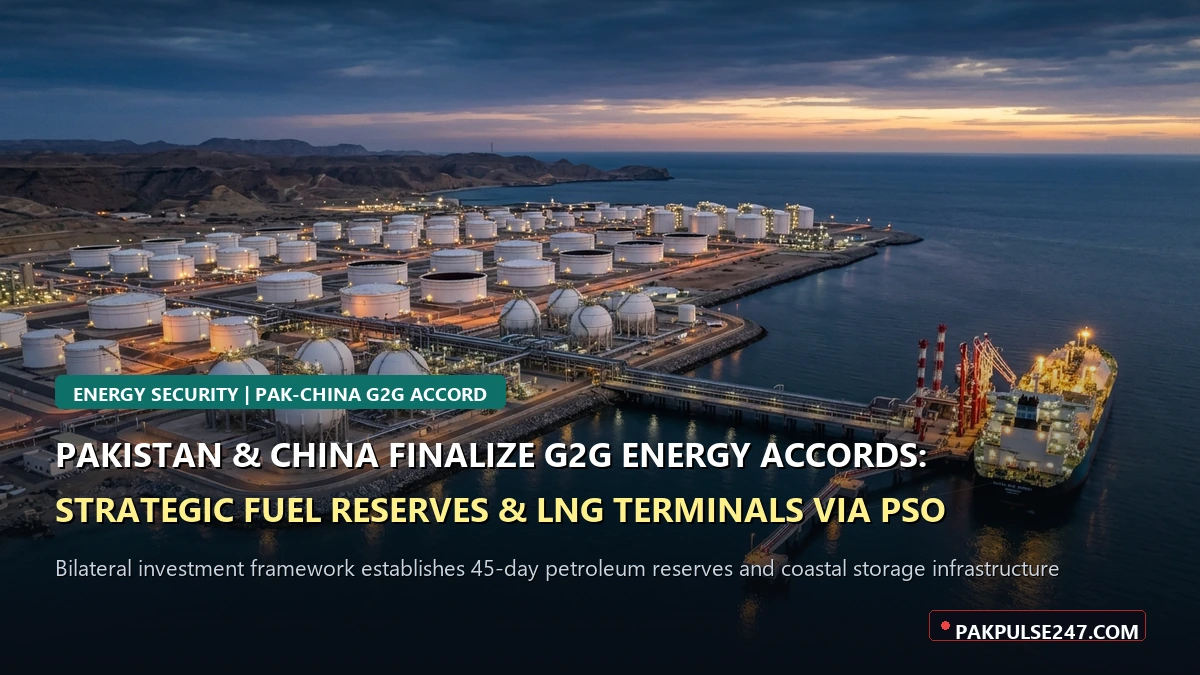
ISLAMABAD / KARACHI: In a transformative initiative designed to insulate the national economy from international maritime disruptions and secure long-term energy sovereignty, Pakistan and China have officially concluded a landmark government-to-government (G2G) investment framework for strategic fuel reserves and coastal LNG infrastructure.
Expanding Strategic Petroleum Reserves to 45 Days
Under the bilateral bilateral accords finalized between the Ministry of Energy (Petroleum Division) and top Chinese state energy conglomerates, the two nations will co-finance and build expansive crude and finished petroleum storage reservoirs across strategic coastal and inland corridors. The project will effectively elevate Pakistan’s strategic petroleum reserves (SPR) from current two-week operational thresholds to a robust 45-day emergency buffer.
PSO to Serve as Commercial Anchor
Pakistan State Oil (PSO), the country's national oil marketing flagship, has been designated as the lead operational entity for executing the commercial joint ventures. The G2G agreement encompasses modern cryogenic liquefied natural gas (LNG) terminals, pressurized LPG reception units along the Balochistan coast, and dedicated pipeline interconnects linking deepwater berths to domestic refining corridors.
Upstream Mineral Exploration Logistics
Beyond fuel stockpiling, the comprehensive bilateral roadmap integrates specialized heavy logistics networks to support joint upstream mineral extraction and refining operations in mineral-rich districts of Balochistan, facilitating seamless bulk transport to Gwadar and Karachi export terminals under the expanded Phase-II of the China-Pakistan Economic Corridor (CPEC).
Shielding Pakistan from Global Energy Volatility
Energy strategists and market analysts have emphasized that establishing sovereign fuel storage infrastructure significantly shields Pakistan from volatile geopolitical choke-points and global tanker supply shocks. For comprehensive reporting on national energy policies, corporate investments, and strategic infrastructure developments, visit the Pak Pulse 247 News Desk.