
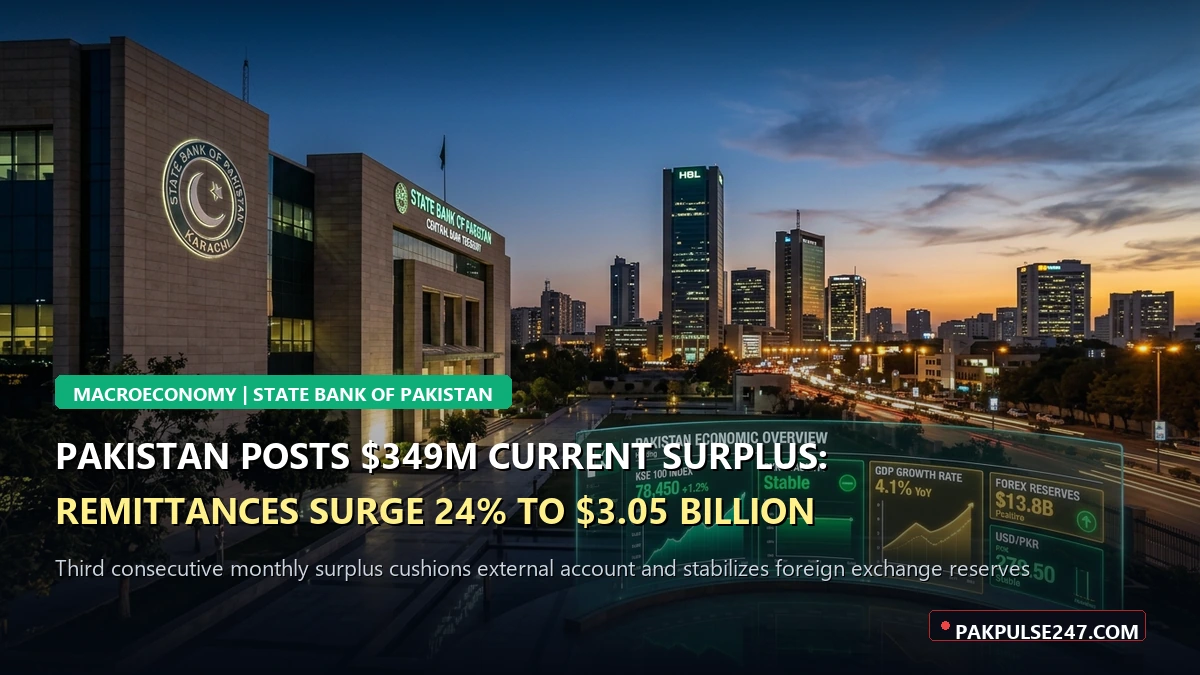
KARACHI — Pakistan's external balance of payments demonstrated strong macroeconomic stability as the country posted a current account surplus of $349 million for October, according to official data released by the State Bank of Pakistan (SBP). The performance marks the third consecutive month of a current account surplus, representing a dramatic turnaround from the $287 million deficit recorded during the corresponding month of the previous fiscal year.
Historic Surge in Overseas Workers' Remittances
The robust surplus was predominantly fueled by unprecedented inflows of overseas worker remittances, which reached $3.052 billion in October. This reflects an extraordinary growth of 24 percent year-on-year compared to October of the prior year, and a 7 percent month-on-month increase over September.
According to the central bank's detailed country-wise breakdown, the strongest remittance flows originated from Saudi Arabia ($769.5 million), the United Arab Emirates ($620.9 million), the United Kingdom ($429.4 million), and the European Union ($359.1 million). The widespread transition of remittance channels toward formal banking avenues, aided by narrowing kerb-market premiums and robust digital payment systems, has been instrumental in sustaining monthly inflows above the crucial $3 billion threshold.
Cumulative Fiscal Position and Foreign Exchange Cushion
With October's surplus, Pakistan's cumulative current account balance for the first four months of the fiscal year (July–October) registered a consolidated surplus of $218 million. This contrasts sharply with a massive deficit of $1.53 billion recorded during the same four-month period of the preceding year.
The consistent surplus has provided vital fiscal breathing room to the central bank, enabling SBP's foreign exchange reserves held with the central bank to climb above $11 billion. The enhanced reserve cushion has played a central role in anchoring the Pakistani Rupee (PKR), maintaining foreign exchange stability in the interbank market, and reducing imported inflation pressures across fuel and food staples.
Market Reaction and Macroeconomic Outlook
Financial markets responded positively to the central bank's external account data, with the benchmark KSE-100 index extending its historic bull run on the Pakistan Stock Exchange. Economists note that while compressed imports and record remittances have restored balance of payments equilibrium, sustained long-term economic stability will require accelerating export-oriented industrial growth and attracting non-debt-creating foreign direct investment. For real-time financial reporting and business intelligence, explore PakPulse247's News section and National coverage.