
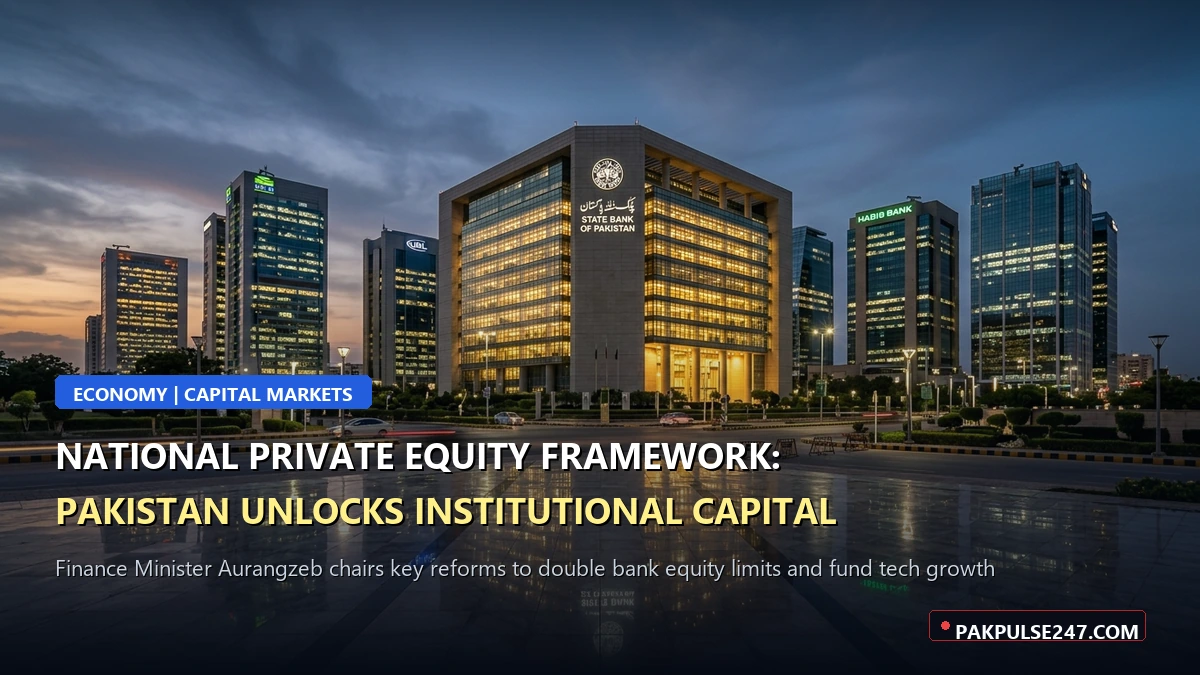
ISLAMABAD — In a major economic policy move aimed at deepening Pakistan's capital markets and modernizing domestic corporate financing, Federal Minister for Finance and Revenue Senator Muhammad Aurangzeb chaired a high-level consultative meeting of the National Private Equity Framework Committee to accelerate foundational reforms in the venture capital and private equity ecosystem.
Doubling Commercial Bank Investment Ceilings to 20 Percent
A central pillar of the newly structured framework involves a significant regulatory revision by the State Bank of Pakistan (SBP), which has moved to double the permissible investment limit for commercial banks in registered private equity and venture capital funds from 10 percent to 20 percent of their paid-up capital. This strategic adjustment aims to release substantial institutional liquidity currently locked in low-yield risk-free government securities directly into high-growth private enterprises.
Finance ministry officials highlighted that commercial banking balance sheets have historically allocated excessive capital toward treasury bills, depriving productive manufacturing industries, renewable energy ventures, and scalable technology startups of patient equity capital. By establishing clear regulatory guardrails, the framework empowers banks to partner with licensed asset management companies and venture funds.
Tax Harmonization and Regulatory Modernization
The committee, which convened key leadership from the Securities and Exchange Commission of Pakistan (SECP), the State Bank, and leading private equity practitioners, addressed longstanding structural impediments, including taxation inconsistencies and exit mechanisms. Key reforms finalized during the session include:
- Harmonizing capital gains tax treatments between listed equities and unlisted private fund holdings to eliminate fiscal arbitrage.
- Streamlining SECP licensing procedures for domestic fund managers and establishing pass-through tax status for recognized investment vehicles.
- Implementing modernized regulatory sandboxes to support early-stage venture funding in fintech, agritech, and export-oriented software development.
- Facilitating seamless foreign exchange repatriation channels for global co-investors participating in domestic funds.
Catalyzing Productive Economic Growth and Job Creation
Speaking during the deliberations, Senator Aurangzeb reiterated that structural economic stabilization requires shifting Pakistan from an import-dependent, debt-financed economic model to an investment-driven and export-oriented economy. The finance minister stated that vibrant private equity markets serve as the global engine for employment creation, technological innovation, and corporate governance enhancement.
The final framework recommendations will be presented to the federal cabinet for formal statutory ratification next month, providing a transparent, predictable roadmap for institutional asset managers, pension funds, and insurance companies to participate in Pakistan's economic modernization. For real-time financial reporting, fiscal policy updates, and corporate markets intelligence, visit PakPulse247's Economy desk and News section.