
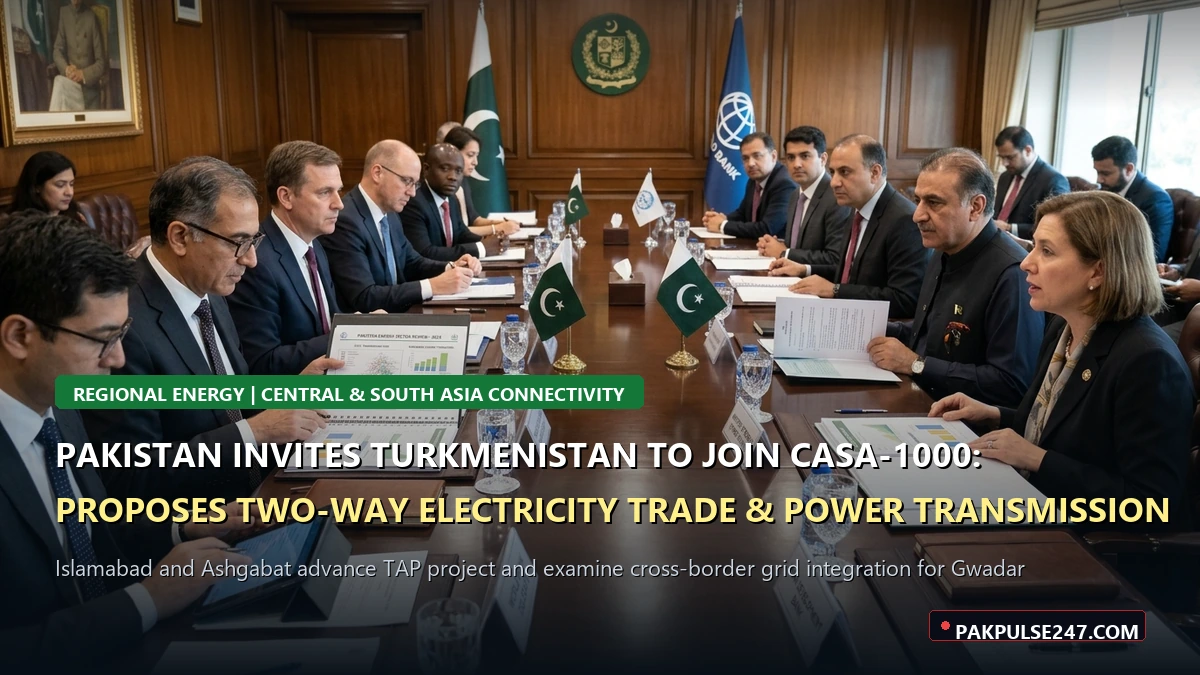
ISLAMABAD: In a decisive step toward unlocking cross-border energy connectivity across Central and South Asia, the Government of Pakistan has formally invited the Republic of Turkmenistan to join the landmark CASA-1000 (Central Asia-South Asia) electricity transmission project. The initiative was extended during a high-profile bilateral summit in Islamabad between Pakistan's Federal Minister for Energy, Sardar Awais Ahmad Khan Leghari, and Turkmenistan’s Minister of Energy, Annageldi Saparov.
Transitioning CASA-1000 to a Bidirectional Electricity Exchange
During the ministerial deliberations, Islamabad proposed a strategic conceptual redesign of CASA-1000, recommending that the regional grid evolve from its original unilateral structure—which moves power exclusively from Central Asia to South Asia—into a dynamic two-way electricity exchange. Under the proposed model, participating states would trade electricity seasonally based on counter-cyclical surplus and deficit periods, substantially strengthening the financial viability and dispatch resilience of the multi-country infrastructure.
Accelerating the 1,200 MW TAP Power Corridor
The bilateral meeting also conducted an exhaustive review of the Turkmenistan-Afghanistan-Pakistan (TAP) power transmission project. Designed to transmit up to 1,200 megawatts of electricity over an 1,150-kilometer corridor into Quetta, the Turkmen delegation confirmed that Ashgabat has completed its physical transmission line infrastructure up to the Afghan border. Both ministries resolved to activate joint technical working groups to harmonize grid synchronization parameters and finalize data-sharing frameworks.
Regional Grid Expansion and the Gwadar Industrial Link
Minister Leghari noted that Pakistan has encouraged existing upstream partners—Tajikistan and the Kyrgyz Republic—to support integrating both Uzbekistan and Turkmenistan into a unified regional transmission pool. Furthermore, acknowledging the rapid escalation of commercial and industrial power demand in the port city of Gwadar, Pakistan proposed that technical teams from Turkmenistan, Iran, and Pakistan explore tripartite wheeling arrangements utilizing the existing Iranian cross-border grid network.
Strategic Regional Geoeconomics
Energy analysts view the synchronization of Central Asian power suppliers with South Asian load centers as vital for lowering average generation basket costs in Pakistan while providing Central Asian republics with long-term export markets. For exhaustive coverage on regional energy treaties, infrastructure corridors, and diplomatic dialogues, visit the Pak Pulse 247 News Desk.