
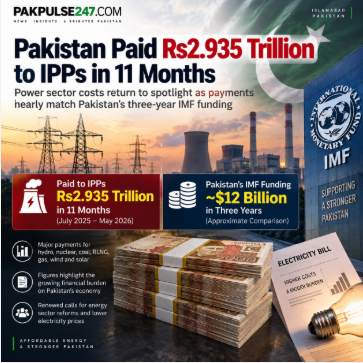
Pakistan paid approximately Rs2.935 trillion to independent power producers and other power plants during the first 11 months of fiscal year 2025-26, putting the enormous cost of electricity generation back at the centre of the national economic debate.
The payments covered the period from July 2025 to May 2026, while billing for June had not been completed when the figures were compiled, meaning the final annual amount could be higher.
The disclosure has gained attention at a time when households and businesses continue to closely watch electricity tariffs, capacity payments and the wider financial health of Pakistan's power sector.
Rs2.935 Trillion Paid in Just 11 Months
Figures presented by the Ministry of Energy show the scale of payments flowing through Pakistan's electricity generation system.
Hydropower remained the country's largest source by electricity generated during the period, while major payments also went to nuclear, imported coal, RLNG, gas, wind, solar and bagasse-based generation.
Imported coal plants alone received more than Rs637 billion, while RLNG-based plants received more than Rs527 billion during the reported period.
Nuclear power generation accounted for payments of around Rs469 billion, while hydropower plants received approximately Rs375 billion.
These figures underline how Pakistan's electricity bill is shaped not by a single generation source but by a complex mix of fuel costs, contractual obligations and power-purchase arrangements.
Capacity Payments Back in Public Debate
One of the most controversial parts of Pakistan's power-sector structure remains capacity payments.
Under many power-purchase agreements, generators receive capacity-related payments for maintaining agreed generation availability even when all available electricity is not actually dispatched to consumers.
Supporters of the system argue that such payments are part of legally binding contracts required to ensure generation capacity remains available when demand rises.
Critics, however, question whether the current structure remains affordable for an economy where electricity prices have already become a significant expense for households, manufacturers and commercial users.
The latest payment figures have therefore renewed calls for a closer examination of power contracts, generation costs and the long-term sustainability of the existing electricity market.
Why Electricity Costs Remain an Economic Issue
Pakistan has spent years dealing with circular debt, transmission losses, electricity theft, inefficient distribution companies and the financial consequences of earlier power-sector agreements.
When revenues collected from consumers are insufficient to cover the full cost of electricity supplied across the system, unpaid obligations accumulate and contribute to circular debt.
At the same time, raising tariffs to recover those costs can place additional pressure on consumers and increase production expenses for businesses.
This leaves policymakers facing a difficult balance: keeping the power sector financially viable while making electricity affordable enough to support households, industry and economic growth.
IMF Also Wants Energy-Sector Reforms
Energy-sector viability remains an important part of Pakistan's economic reform programme with the International Monetary Fund.
The IMF has repeatedly stressed the need for reforms aimed at improving power-sector finances, reducing structural weaknesses and limiting the accumulation of new liabilities.
Pakistan's previous IMF Stand-By Arrangement provided about $3 billion, while disbursements under the country's current Extended Fund Facility and Resilience and Sustainability Facility had reached about $4.8 billion by May 2026.
This means comparisons circulating online between IPP payments and IMF financing need to be treated carefully because they often combine different periods, currencies and categories of expenditure.
Pressure Builds for Cheaper and Sustainable Power
For consumers, the debate ultimately comes down to the price paid on monthly electricity bills.
For the government, however, the challenge is broader: Pakistan needs enough generation capacity to avoid shortages while also reducing costly inefficiencies and attracting investment into cheaper sources of power.
Renegotiation of power agreements, improvements in distribution companies, reduction of line losses, increased recovery of electricity bills and investment in lower-cost generation are all likely to remain central to the energy debate.
The Rs2.935 trillion paid during just 11 months illustrates the sheer financial scale of Pakistan's electricity system — and why meaningful power-sector reform remains one of the country's most important economic challenges.