
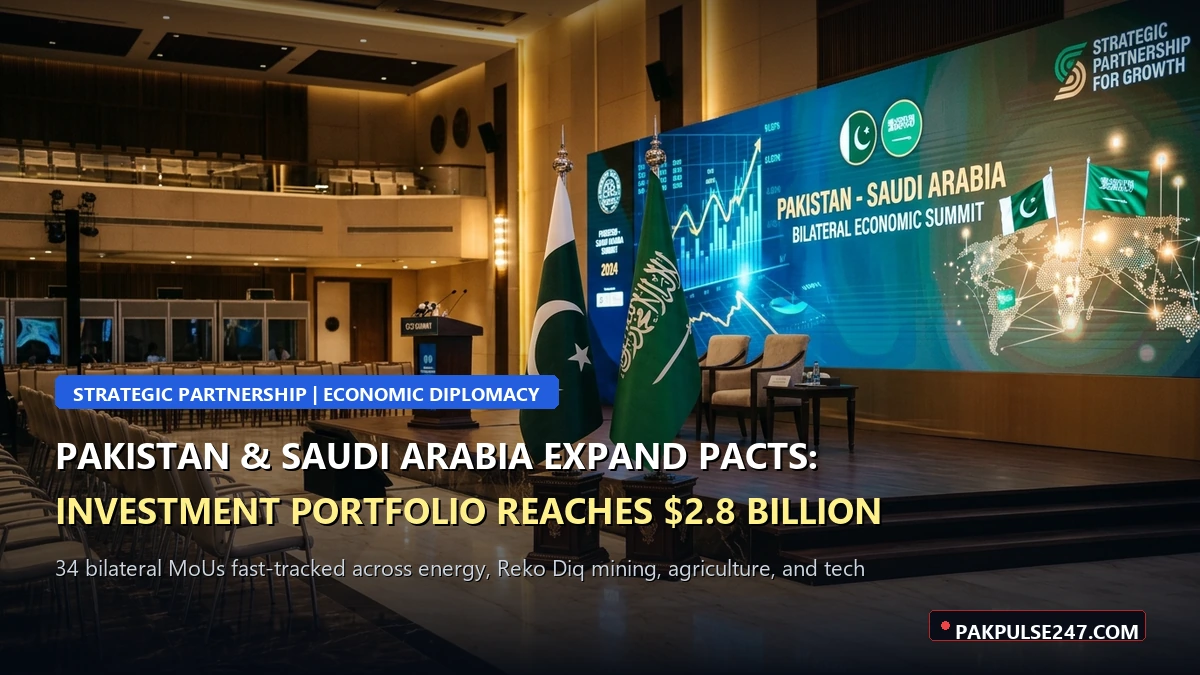
ISLAMABAD / RIYADH — Pakistan and the Kingdom of Saudi Arabia have formally expanded their strategic bilateral investment cooperation framework, scaling the total commitment to $2.8 billion across 34 memorandums of understanding (MoUs). The announcement follows high-level bilateral deliberations aimed at accelerating joint venture implementations in key economic sectors including minerals, petroleum, green power, agriculture, and information technology.
Expanding Bilateral Economic Architecture
The bilateral investment package initially comprised 27 agreements valued at $2.2 billion signed during the official visit of a high-powered Saudi business delegation led by Minister of Investment Sheikh Khalid Bin Abdul Aziz Al Faleh to Islamabad. Following follow-up ministerial meetings in Riyadh, seven additional agreements were finalized, adding over $600 million in capital commitments to the bilateral portfolio.
Officials from Pakistan's Special Investment Facilitation Council (SIFC) confirmed that multiple MoUs have already progressed from preliminary intent into detailed project feasibility and execution stages, supported by specialized joint working groups.
Key Sectors: Reko Diq, Energy, and Digital Infrastructure
A central pillar of the expanded portfolio centers on high-impact mineral exploration, specifically the prospective entry of Saudi Arabian mining consortium Manara Minerals into Pakistan's world-class Reko Diq copper and gold venture in Balochistan. The discussions include sovereign equity participation alongside Barrick Gold Corporation.
Other major agreements encompass petrochemical refining infrastructure, solar and wind energy generation parks, state-of-the-art medical and diagnostic complexes, semiconductor chip design collaboration, and agricultural logistics networks designed to bolster Gulf food security.
Strategic Economic Stabilization
Prime Minister Shehbaz Sharif noted that the historic expansion reflects deep fraternal trust and strategic convergence between Islamabad and Riyadh. The targeted foreign direct investment (FDI) inflows are poised to fortify Pakistan's foreign exchange reserves, generate specialized domestic employment, and enhance modern industrial productivity under macroeconomic stability reforms. For ongoing coverage of national policy and foreign trade, visit PakPulse247's News desk and Business section.