
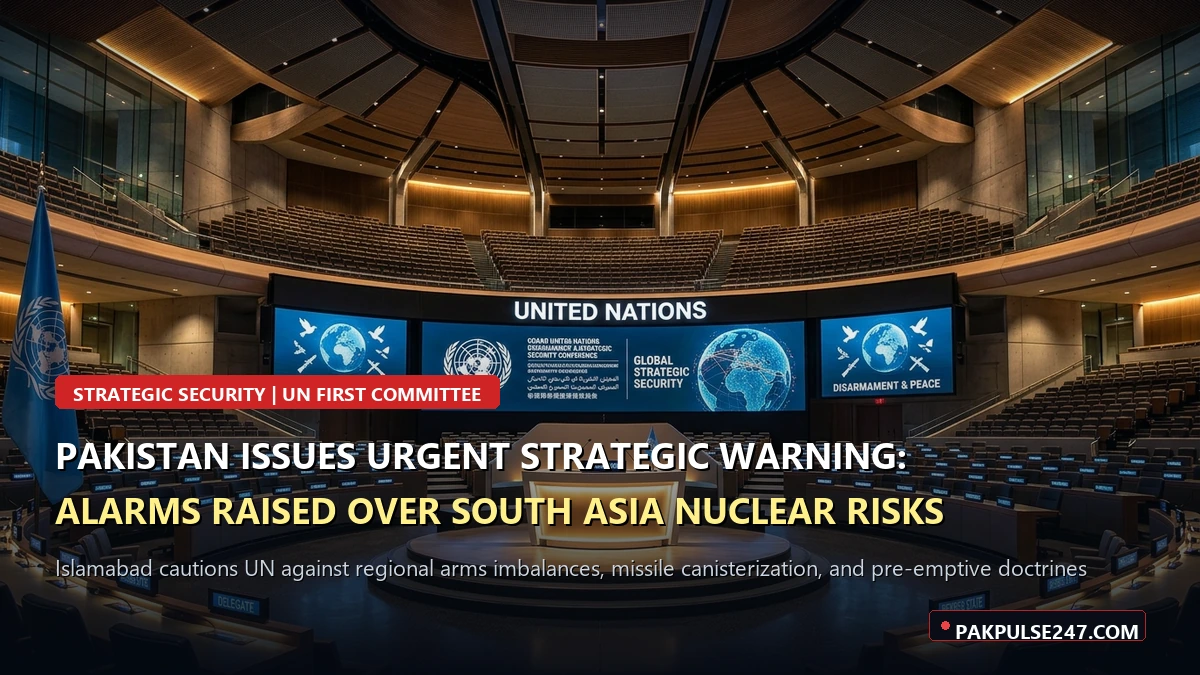
UNITED NATIONS, NEW YORK — Pakistan has delivered a comprehensive strategic warning before the United Nations General Assembly First Committee (Disarmament and International Security), sounding urgent alarms over the progressive unraveling of strategic stability and deterrence equilibrium across South Asia. In a formal statement on nuclear weapons and regional security architectures, Pakistani delegates emphasized that unilateral military expansion and preferential non-proliferation waivers risk precipitating dangerous miscalculations in the region.
Critique of Selective Safeguards and Strategic Imbalances
Addressing delegates during the thematic debate on nuclear disarmament, Pakistan’s diplomatic mission underscored that the global non-proliferation framework has been compromised by discriminatory exceptions, geographic selectivity, and technology transfers that fuel regional asymmetry. The delegation highlighted that unchecked access to advanced dual-use technologies and unsafeguarded fissile material production facilities enables aggressive military posturing in South Asia.
Pakistani officials made clear that Islamabad will not acquiesce to any artificial strategic imbalance imposed on the region. The delegation reaffirmed that maintaining a credible minimum deterrence posture remains the cornerstone of Pakistan’s national security doctrine in response to conventional imbalances and expanding ballistic missile shield deployments.
Missile Canisterization and Pre-Emptive Counterforce Concerns
A key focus of Pakistan’s presentation centered on evolving technological and doctrinal shifts in the regional neighborhood. The delegation drew attention to international defense analyses, including assessments from the Stockholm International Peace Research Institute (SIPRI), pointing toward the operational deployment of submarine-launched nuclear warheads and the canisterization of intercontinental and intermediate-range ballistic missiles.
Pakistani strategic experts warned that missile canisterization—mating nuclear warheads to propulsion units during peacetime—erodes reaction times, lowers the nuclear threshold, and incentivizes dangerous pre-emptive counterforce doctrines. In a crisis environment, compressed decision-making timelines drastically elevate the danger of accidental, unauthorized, or inadvertent escalation between nuclear-armed neighbors.
Diplomatic Proposals for Regional Restraint
Reiterating its diplomatic posture, Pakistan called for meaningful, institutionalized dialogue on a Strategic Restraint Regime (SRR) for South Asia, encompassing three interlocking pillars: conflict resolution, conventional balance, and mutual nuclear and missile restraint. As Pakistan concludes its rotational presidency of the Conference on Disarmament (CD), Islamabad urged major global powers to uphold non-discriminatory principles and avoid destabilizing weaponization pacts. For verified diplomatic updates and international strategic affairs, explore the PakPulse247 News section and National reporting.