
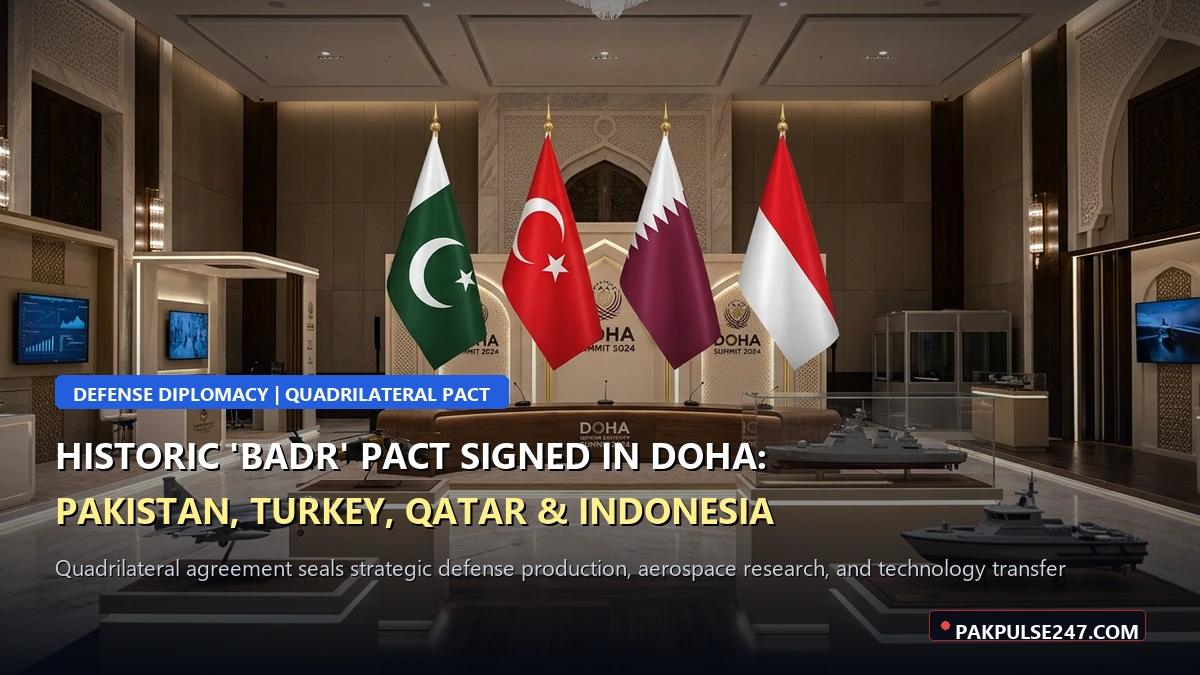
DOHA / ISLAMABAD — In a major strategic breakthrough for multilateral military cooperation, Pakistan, Turkey, Qatar, and Indonesia have formally signed a quadrilateral defense agreement titled the 'Badr Memorandum of Understanding' (MoU) during high-level defense ceremonies in Doha, Qatar. The historic pact establishes a collaborative framework aimed at co-developing advanced military technologies, integrating supply chains, and expanding joint production across land, air, and naval defense platforms.
Quadrilateral Signatories and Strategic Framework
The agreement was signed by defense chiefs and cabinet ministers representing all four partner states, including Pakistan's Defence Minister Khawaja Muhammad Asif, Turkish National Defence Minister Yaşar Güler, Qatar's Deputy Prime Minister and Minister of State for Defence Affairs Sheikh Saud bin Abdulrahman Al Thani, and Indonesian Deputy Defence Minister Yusuf Jauhari. The head of Turkey's Presidency of Defence Industries (SSB), Haluk Görgün, was also in attendance.
Named after the Arabic term for 'full moon', the Badr pact is designed to transition the partner countries from transactional arms procurement to deep industrial co-production, joint defense research, and specialized technical military training exchanges.
Industrial Synergy and Joint Manufacturing
Under the terms of the MoU, the four nations will pool their respective industrial and technical capabilities:
- Defense Industrial Synergy: Combining Turkey's cutting-edge aerospace and unmanned combat aerial vehicle (UCAV) expertise with Pakistan's heavy ordnance and conventional manufacturing infrastructure.
- Naval and Electronics Integration: Enhancing naval shipbuilding, radar electronics, and missile defense technologies through joint research programs.
- Supply Chain Resilience: Securing indigenous supply chains for critical components to mitigate foreign export restrictions and external sanctions.
- Financial and Regional Depth: Leveraging Qatar's investment capability alongside Indonesia's expansive Southeast Asian defense market and maritime domain requirements.
Regional Geopolitical Implications
Strategic analysts note that the Badr agreement represents a significant evolution in South-South defense collaboration, providing a unified platform for friendly nations to achieve collective self-reliance in modern defense capabilities without depending on traditional Western supplier cartels.
The defense ministers agreed to establish permanent joint working groups to coordinate immediate projects and schedule technical reviews between defense industrial complexes across Islamabad, Ankara, Doha, and Jakarta. For in-depth geopolitical and defense coverage, visit PakPulse247's News section and Pakistan desk.