
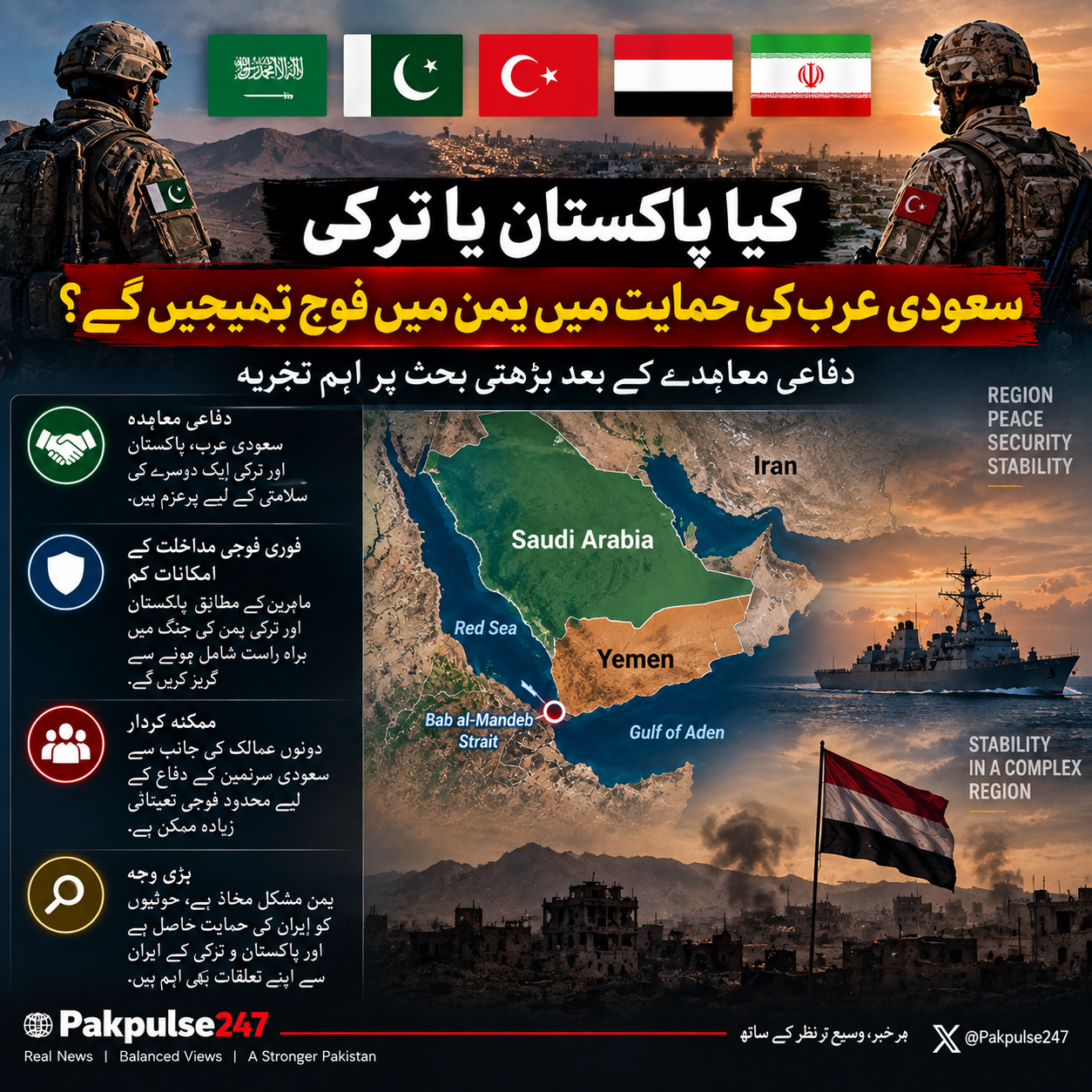
Renewed Houthi attacks on Saudi Arabia and the rapidly changing battlefield in Yemen have sparked a major regional question: could Pakistan and Turkiye be drawn into the Yemen conflict under their recently signed Makkah Defence Agreement with Saudi Arabia?
For now, the available signals suggest a clear distinction between defending Saudi territory and becoming directly involved in another ground war inside Yemen.
Pakistan, Saudi Arabia and Turkiye are members of the Makkah Defence Agreement, a collective security arrangement built around the principle that an attack against one member can become a matter of concern for all three.
But that does not automatically mean Pakistani or Turkish forces will enter Yemen.
Pakistan Says No Military Response Is Currently Under Discussion
Pakistan's Foreign Office has already attempted to lower speculation surrounding an immediate military intervention.
Islamabad has said that no military response under the Makkah Defence Agreement is currently being discussed following the latest Houthi attacks on Saudi Arabia.
At the same time, Pakistan has stressed that the agreement remains in force and that the country will meet its commitments if circumstances require action.
That leaves Islamabad with considerable room between diplomatic support, defensive military cooperation and direct participation in combat.
Pakistan's Defence Minister Khawaja Asif has also indicated that continued attacks on Saudi territory could bring the defence agreement into play.
The key issue, therefore, may not be what happens inside Yemen but whether the conflict continues to spill across the Saudi border.
Defending Saudi Arabia Is Different From Entering Yemen
This distinction could become central to Pakistan and Turkiye's calculations.
Deploying forces or defence systems inside Saudi Arabia to protect cities, military installations, airports or energy facilities would be fundamentally different from sending troops across the border to fight Houthi forces inside Yemen.
Saudi Arabia has faced repeated missile and drone attacks from Houthi-controlled areas.
In such a scenario, additional air-defence support, intelligence cooperation, training, logistics or troops assigned specifically to protect Saudi territory would fit far more naturally within the framework of a defensive alliance.
A large-scale ground operation in Yemen would carry far greater military and political risks.
Why Yemen Remains a Difficult Battlefield
Yemen has repeatedly demonstrated how difficult it is for outside powers to achieve a decisive military outcome.
The country's mountainous terrain, tribal structure, fragmented political landscape and long-running internal conflict have made conventional military campaigns extremely difficult.
The Houthis, also known as Ansarullah, have accumulated years of combat experience and developed a significant missile and drone capability.
They also maintain close political and military ties with Iran.
A foreign intervention would therefore risk turning a defensive commitment to Saudi Arabia into a much wider regional confrontation.
Neither Pakistan nor Turkiye has publicly indicated that it intends to take that path.
Iran Factor Complicates Any Direct Intervention
Iran is another major consideration.
Pakistan shares a long border with Iran and has repeatedly emphasised the importance of maintaining working relations with Tehran.
Islamabad has also attempted to play a diplomatic role during periods of regional escalation.
Becoming a direct combatant against an Iranian-aligned movement inside Yemen could place Pakistan's relationship with Tehran under severe pressure and create additional security problems along its western frontier.
Turkiye also maintains substantial diplomatic, economic and regional engagement with Iran despite differences between Ankara and Tehran on several Middle Eastern issues.
That gives both countries a strong incentive to avoid allowing the Yemen conflict to become a direct confrontation with Iran.
Turkiye Backs Saudi Security but Still Calls for Political Solution
Ankara has strongly condemned recent Houthi attacks on Saudi Arabia and reaffirmed its support for Saudi sovereignty and territorial integrity.
At the same time, Turkiye has continued to emphasise a political settlement to the Yemen conflict.
That combination is significant.
It indicates firm political backing for Saudi Arabia without necessarily signalling a Turkish decision to send combat forces into Yemen.
For Ankara, as for Islamabad, strengthening Saudi Arabia's defensive capability could therefore remain a more realistic option than opening another military front.
Makkah Defence Pact Faces Its First Major Test
The renewed Saudi-Houthi confrontation has nevertheless created the first serious test of the Makkah Defence Agreement.
Until now, much of the focus surrounding the alliance had been on deterrence, military cooperation and broader regional security.
Houthi missile and drone attacks on Saudi territory have now turned those principles into an immediate practical question.
How far are Pakistan and Turkiye prepared to go if attacks on Saudi Arabia continue?
That answer may depend heavily on whether the conflict remains centred inside Yemen or begins to pose a sustained threat to Saudi territory.
Pakistani Forces Could Have a Defensive Role
Pakistan already has a long history of defence cooperation with Saudi Arabia, including military training and other security arrangements.
If the crisis continues to escalate, a defensive deployment would therefore be considerably easier politically and strategically than participation in an offensive campaign inside Yemen.
Possible roles could include protecting sensitive locations, training Saudi personnel, intelligence cooperation and supporting defensive operations against missiles and drones.
None of these steps would necessarily require Pakistan to enter the Yemeni battlefield.
Direct Yemen Intervention Remains a Much Bigger Decision
For Pakistan or Turkiye to send combat forces into Yemen would require a far more consequential political decision.
It could expose their forces to a prolonged conflict, complicate relations with Iran and make them direct participants in one of the Middle East's most difficult wars.
The growing strategic importance of Bab al-Mandeb makes the situation even more sensitive.
Recent Houthi advances toward the crucial maritime route have increased pressure on Saudi Arabia and its partners, particularly as instability around the Strait of Hormuz has already disrupted regional energy and shipping networks.
But military pressure alone does not mean Islamabad or Ankara will choose direct intervention.
What Happens Next?
The most important line to watch is now the Saudi-Yemeni border.
If Houthi operations remain concentrated inside Yemen, Pakistan and Turkiye are likely to have greater room to emphasise diplomacy and avoid direct involvement.
If missile and drone attacks against Saudi Arabia continue or expand, however, pressure to activate the defensive provisions of the Makkah agreement could grow.
Even then, defending Saudi territory would not necessarily mean entering Yemen.
At present, the more plausible scenario is increased defensive cooperation with Riyadh while Pakistan and Turkiye attempt to avoid becoming trapped in a prolonged Yemeni war.
The Makkah Defence Agreement may therefore become operational first as a shield around Saudi Arabia rather than as the basis for a new multinational military campaign inside Yemen.