
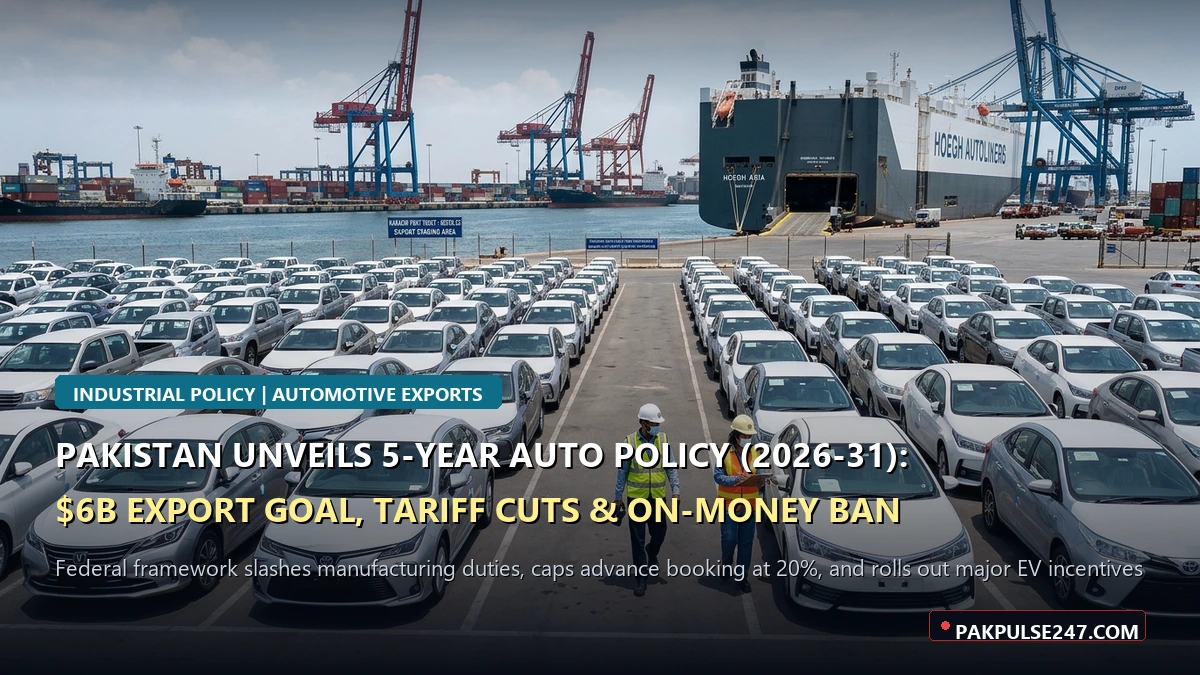
Islamabad: The federal government has formally finalized and unveiled the landmark Automotive Industry Development and Export Policy (2026–31) following technical clearance from the International Monetary Fund (IMF). Designed to pivot Pakistan's automotive ecosystem from a protected domestic market into an export-oriented, globally competitive manufacturing hub, the five-year blueprint sets an ambitious cumulative export target of $6 billion (averaging roughly $1.2 billion annually) in vehicles, components, and engineering sub-assemblies.
Phased Tariff Rationalization and Vehicle Price Relief
Under the policy guidelines confirmed by Adviser to the Prime Minister on Industries Haroon Akhtar Khan, the government has instituted a structured multi-year tariff rationalization framework. Import duties on automotive raw materials, completely knocked down (CKD) kits, and localized auto components will experience systematic annual reductions, lowering production overheads across local assembly plants. The cost efficiencies are projected to translate into tangible price reductions for small and mid-range passenger vehicles across the country.
To incentivize compliance, automakers achieving verified localization and export milestones will receive a 5% baseline tax rebate via the Drawback of Local Taxes and Levies (DLTL) program, augmented by an incremental 10% performance incentive. Conversely, manufacturers failing to meet export covenants will face statutory penalties and revocation of fiscal concessions.
Decisive Ban on 'On-Money' and 20% Advance Booking Cap
Addressing longstanding consumer grievances regarding exploitative black-market premiums and delayed deliveries, the policy introduces strict regulatory guardrails on commercial transactions. Automakers and authorized dealership networks are legally prohibited from demanding or collecting more than 20% of a vehicle's invoice price as an advance booking payment. The measure is engineered to dismantle predatory 'on-money' practices and eliminate speculative hoarding by third-party intermediaries.
Furthermore, manufacturers will be mandated to compensate buyers with statutory interest penalties if delivery timelines exceed contractual commitments.
Electric Vehicle (EV) Transition and Financing Expansion
Accelerating Pakistan's clean mobility transition, the policy introduces aggressive tax incentives for electric vehicles. Fully electric passenger cars will be subject to a preferential 1% General Sales Tax (GST), while conventional vehicles displacing 1,000cc or below are granted blanket exemptions from the Automotive Development Levy (ADL). Additionally, the State Bank of Pakistan (SBP) will expand concessional auto financing ceilings for green vehicles up to Rs10 million, with extended amortization periods of up to five years.
Enforcement of 45 International Safety Standards
To ensure local production aligns with international crashworthiness and environmental benchmarks, the policy makes compliance with 45 United Nations (WP.29) vehicle safety regulations mandatory across all domestic assembly lines. The policy now heads to the federal cabinet for formal ratification and immediate gazette notification. For comprehensive industrial coverage and economic policy analysis, follow the Pak Pulse 247 business and national news desk.