
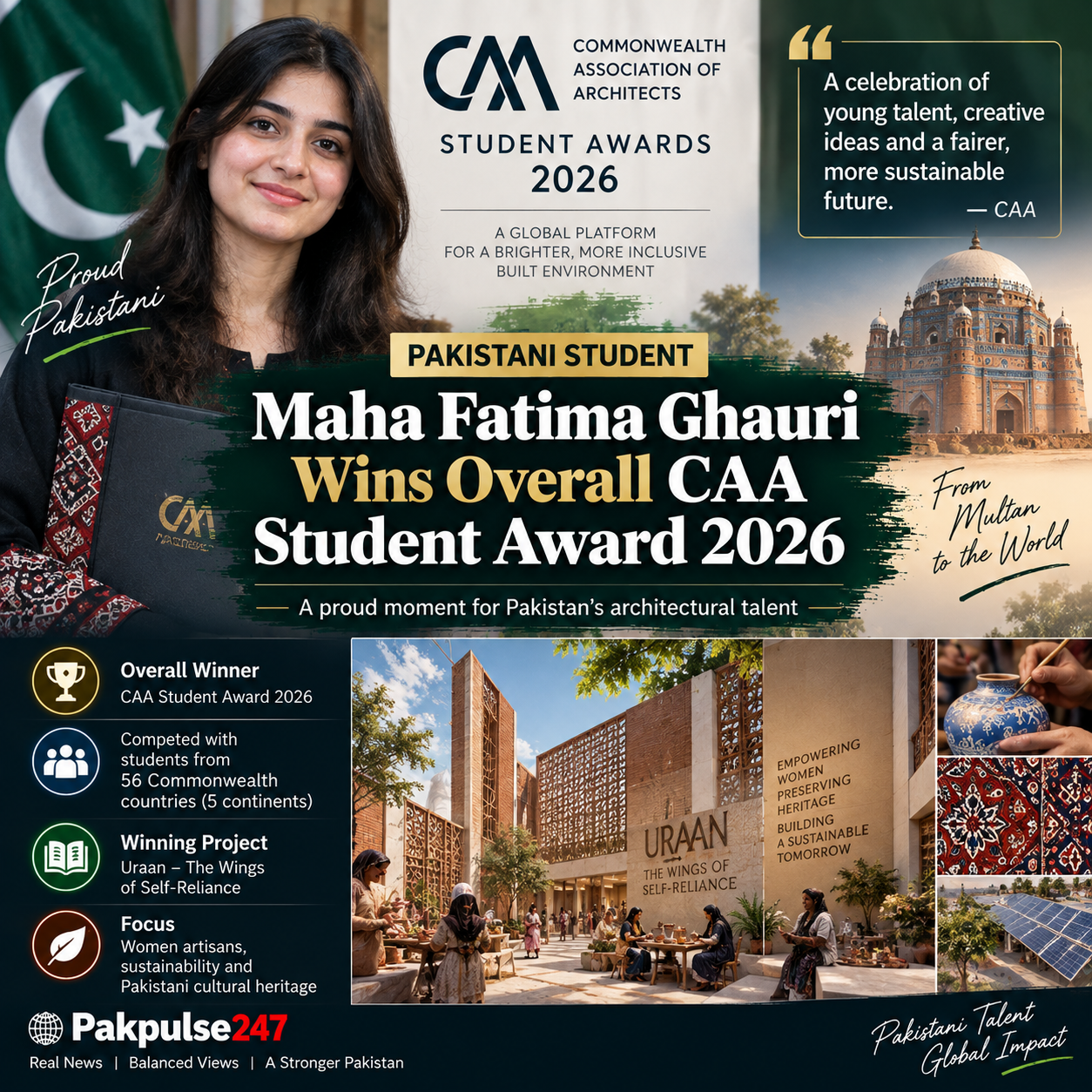
Pakistani architecture student Maha Fatima Ghauri has earned international recognition after being named the Overall Winner of the Commonwealth Association of Architects Student Award 2026, putting Pakistan’s emerging architectural talent in the global spotlight.
Ghauri, a student at the NFC Institute of Engineering & Technology in Pakistan, received the prestigious recognition for her project “Uraan, The Wings of Self-Reliance.”
The 2026 CAA Award winners were announced in Auckland, New Zealand, on September 9, with entries and architectural talent represented through the Commonwealth’s international network spanning 56 countries and five global regions.
For Pakistan, however, the significance of Ghauri’s victory extends beyond another international student award.
Her winning project brings together architecture, sustainability, Pakistani cultural identity and the economic empowerment of women artisans — turning a student design into a proposal addressing a real social challenge.
What Is Maha Fatima Ghauri’s Winning Project ‘Uraan’?
The project that earned Maha Fatima Ghauri the overall CAA Student Award is called “Uraan, The Wings of Self-Reliance.”
Rather than designing a conventional commercial building, Uraan focuses on women artisans in Multan and the economic challenges they face.
The concept proposes an empowering space where female craftspeople can work safely, collaborate, develop their businesses and gain improved access to markets.
At the heart of the project is the idea that architecture can do more than create visually attractive buildings. It can help address social and economic inequality.
The design includes adaptable working areas, a communal courtyard and an entrepreneurial hub intended to connect artisans with wider economic opportunities.
Pakistani Culture Becomes Part of Contemporary Architecture
One of the standout features of Ghauri’s project is its use of Pakistan’s traditional crafts as part of a contemporary architectural language.
The project draws inspiration from Ajrak, Multani blue pottery, mashrabiya screens and Ralli quilt traditions.
Instead of treating these crafts simply as decoration, the concept incorporates their visual identity and cultural meaning into the architecture itself.
That approach allowed the project to present an unmistakably Pakistani identity while addressing issues that are relevant internationally, including women’s economic participation, sustainable construction and community-focused urban spaces.
It is this combination of local identity and global relevance that helped distinguish Uraan at an international level.
Sustainability Is Built Into the Design
Environmental performance is another important element of the winning proposal.
Uraan incorporates passive cooling techniques intended to reduce dependence on energy-intensive mechanical cooling.
The project also includes solar power and rainwater harvesting, helping create a more self-sustaining model suited to Pakistan’s environmental conditions.
These elements are particularly relevant to the CAA Student Award, which recognises student work addressing social, economic and environmental well-being while responding to the challenges of climate change and biodiversity loss.
Ghauri’s design therefore does not treat sustainability as an additional feature.
It makes sustainability part of the architecture from the beginning.
International Jury Praises Uraan
The international jury highlighted the way Uraan responds to the economic marginalisation faced by women artisans in Pakistan.
The judges particularly recognised its ability to reinterpret traditional Pakistani craftsmanship in a modern architectural form while creating safe and adaptable spaces for women.
The jury also highlighted the project’s entrepreneurial component, which seeks to connect craftspeople with markets rather than limiting the proposal to a conventional workspace.
This makes the project both architectural and socioeconomic in its ambition.
At a time when architecture schools around the world are increasingly asking students to design solutions for genuine social and environmental problems, Uraan presents a distinctly Pakistani response to that challenge.
Why the CAA Student Award Matters
The Commonwealth Association of Architects, commonly known as the CAA, represents the architectural profession across the Commonwealth’s 56 member countries.
Its awards programme recognises architecture and architectural education that demonstrate meaningful environmental and social impact.
The Student Award is specifically aimed at students in the earlier years of architectural education whose projects creatively address social, economic and environmental well-being.
Projects are judged not simply on appearance but also on design quality, innovation and their potential contribution to society.
That makes Ghauri’s selection as the overall winner especially significant for Pakistani architectural education.
Pakistan Gains Recognition in Global Architecture
Pakistan has a rich architectural heritage, from historic Mughal structures and traditional urban settlements to contemporary sustainable architecture.
However, international recognition for young Pakistani designers remains particularly valuable because it brings emerging local talent into global professional conversations.
Maha Fatima Ghauri’s achievement demonstrates that Pakistani architecture students can compete internationally not by abandoning local traditions, but by rethinking those traditions for contemporary problems.
Her project takes techniques and visual references familiar to Pakistan and connects them with modern questions surrounding sustainability, gender, entrepreneurship and social equity.
That gives the project an identity that is simultaneously local and international.
Multan’s Craft Heritage at the Centre of Global Recognition
The connection with Multan also gives Uraan particular significance.
Multan has centuries-old traditions associated with craftsmanship, pottery, textile work and decorative arts.
Yet artisans responsible for preserving these skills often face economic challenges and limited opportunities to connect directly with larger markets.
By placing women artisans at the centre of her architectural concept, Ghauri has linked Multan’s cultural heritage with a practical question: how can design help the people who keep that heritage alive?
Uraan attempts to answer that question through architecture.
Instead of simply creating a museum or exhibition space for traditional crafts, the proposal focuses on the artisans themselves and their ability to become economically self-reliant.
A Proud Moment for Young Pakistani Designers
The recognition has been welcomed within Pakistan’s architecture community as a significant achievement for the country and its young creative professionals.
It also sends an important message to architecture and design students across Pakistan.
International recognition is increasingly linked not only to spectacular buildings but to thoughtful solutions for real communities.
Projects that respond to climate conditions, cultural identity, economic realities and social needs can compete at the highest international level.
Maha Fatima Ghauri’s achievement is therefore more than an individual victory.
It places Pakistani student architecture before an international audience and demonstrates how local culture, sustainable thinking and social purpose can come together in a globally recognised design.
From Multan’s craft traditions to the CAA stage in Auckland, “Uraan, The Wings of Self-Reliance” has turned a Pakistani student project into an international statement about what architecture can achieve when design is connected with people, culture and opportunity.