
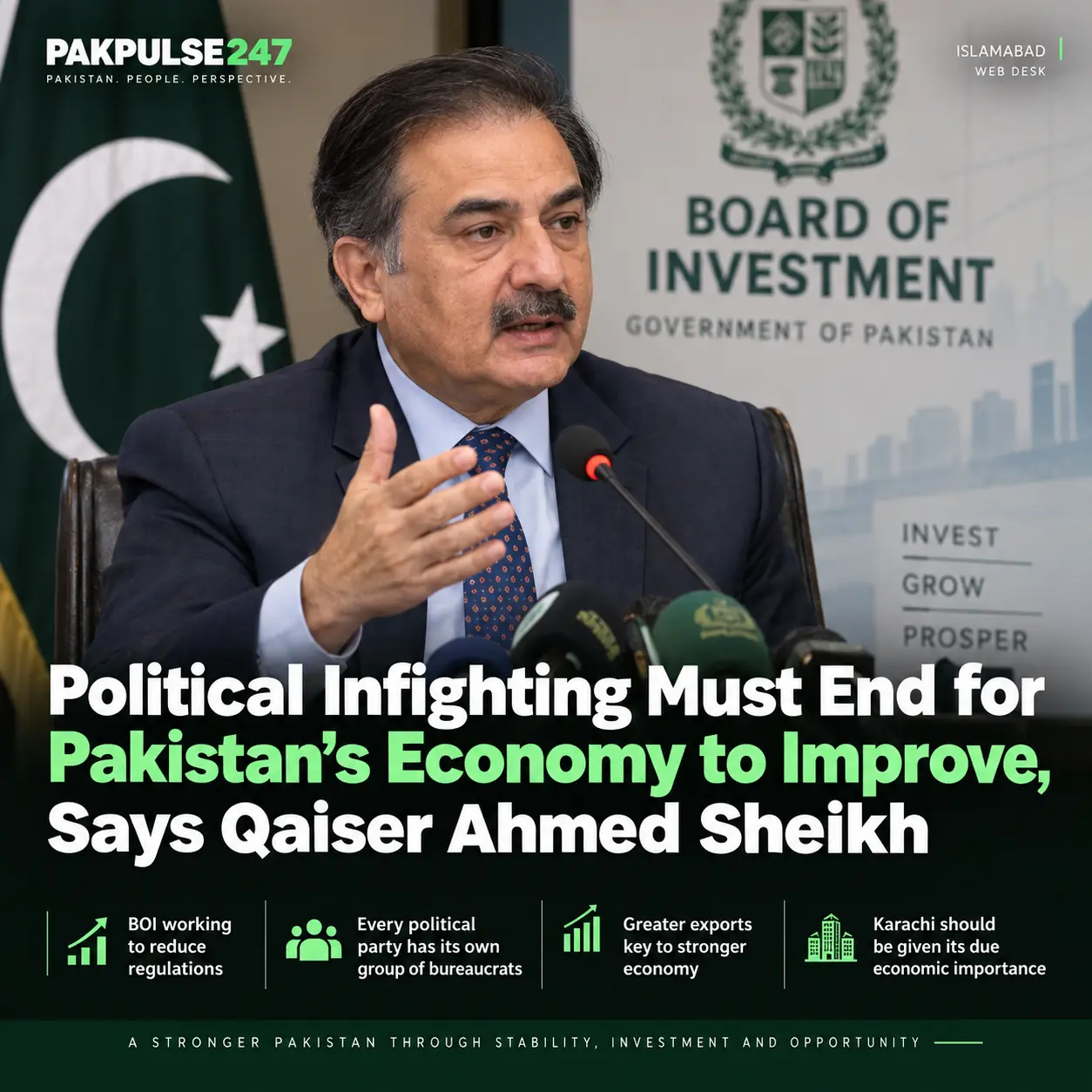
Federal Minister for the Board of Investment Qaiser Ahmed Sheikh has said Pakistan’s economic conditions are unlikely to improve if political parties continue fighting among themselves, stressing that political stability is essential for investment, business growth and long-term economic progress.
Speaking to journalists at the Karachi Press Club, Sheikh said the Board of Investment is working to reduce unnecessary regulations and simplify procedures that create hurdles for businesses and investors.
He argued that persistent political confrontation affects policymaking and slows progress on economic initiatives at a time when Pakistan needs greater investment and stronger private-sector participation.
Board of Investment Working to Reduce Regulations
Qaiser Ahmed Sheikh said regulatory reforms are being pursued to make it easier for businesses to operate and invest in Pakistan.
The government has been working on a broader regulatory reform programme aimed at removing unnecessary requirements, simplifying approval processes and creating a more predictable environment for local and foreign investors.
Reducing regulatory barriers has become an important part of Pakistan’s efforts to improve the ease of doing business and attract private capital into different sectors of the economy.
Political Differences Affect Economic Progress
Commenting on the political environment, Sheikh said every political party has groups within the bureaucracy associated with it, adding that continued political confrontation ultimately affects governance and economic decision-making.
He stressed that Pakistan needs greater political understanding and continuity in economic policies if the country is to achieve sustainable growth.
His remarks come amid an ongoing national debate over the impact of political instability on investment, economic confidence and policymaking.
Pakistan Needs Stronger Export Growth
The federal minister also highlighted the importance of increasing Pakistan’s exports, noting that several countries have strengthened their economies by building competitive export sectors.
He said diplomatic efforts can help open doors for Pakistan internationally, but the private sector must take advantage of emerging opportunities by expanding exports, developing new markets and increasing investment.
Pakistan has been attempting to strengthen export-led growth as policymakers seek ways to improve foreign exchange earnings and reduce pressure on the country’s external finances.
Karachi’s Economic Role Highlighted
Qaiser Ahmed Sheikh described Karachi as Pakistan’s economic hub and highlighted its significant contribution to national revenue and economic activity.
He said the city should receive attention in line with its economic importance and called for measures that could further strengthen Karachi’s business and investment environment.
Karachi remains home to some of Pakistan’s largest businesses, financial institutions, industrial zones and ports, making its economic performance closely linked with the broader national economy.
Political Stability and Investment Remain Closely Linked
Sheikh’s comments place political stability, regulatory reform and private-sector investment at the centre of Pakistan’s economic debate.
With the government seeking to attract investment and remove regulatory hurdles, the effectiveness of these reforms will also depend on policy consistency, institutional coordination and the confidence of businesses considering long-term investment in Pakistan.