
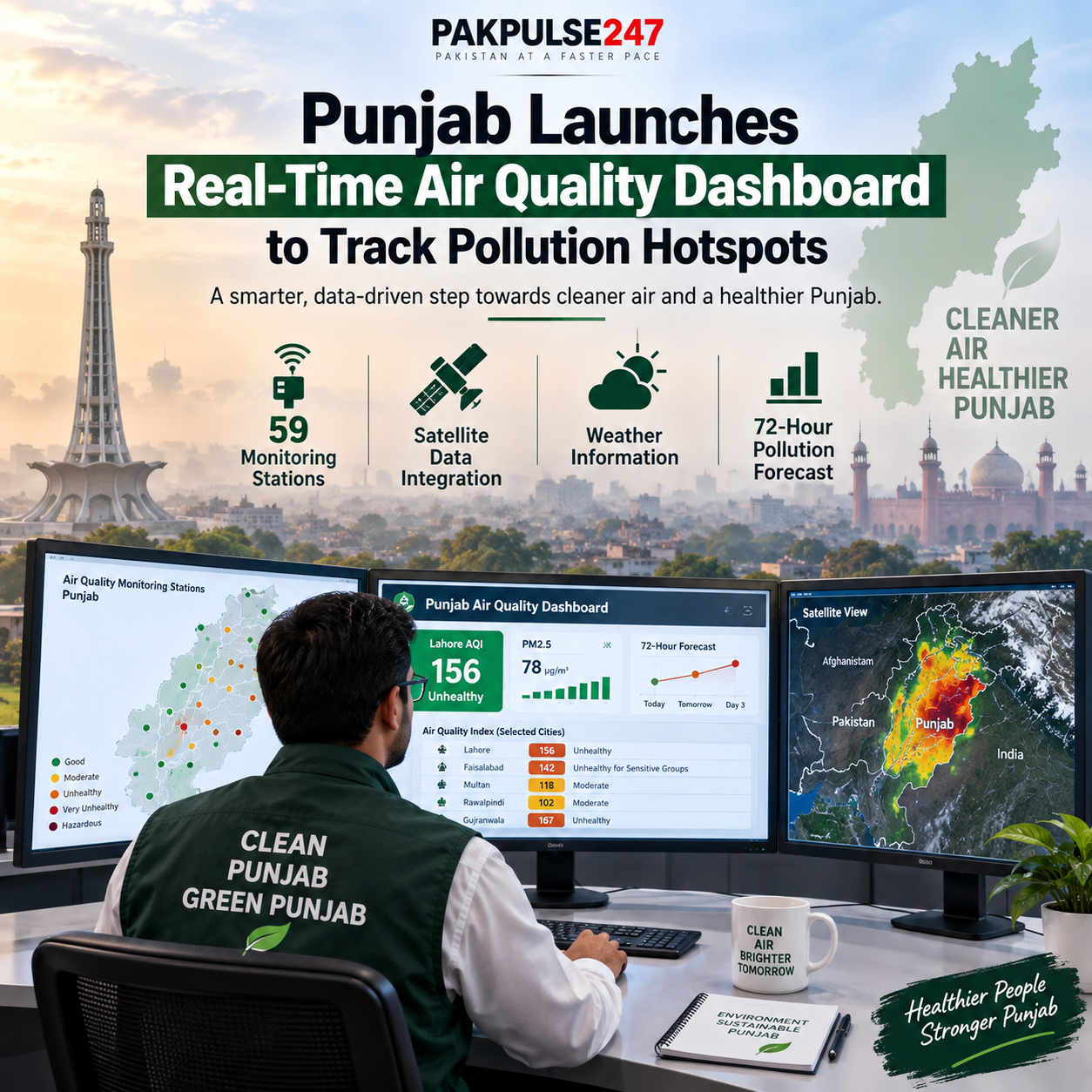
The Punjab government has introduced an advanced Real-Time Air Quality Dashboard to strengthen pollution monitoring, identify emerging hotspots and support faster action in areas experiencing deteriorating air quality.
The upgraded system brings together data from ground-based monitoring stations, satellite observations, weather information and air pollution forecasting on a single platform, giving authorities a broader picture of changing environmental conditions across Punjab.
The initiative comes as air pollution and seasonal smog remain major environmental challenges in Lahore and several other urban areas of the province.
Punjab Expands Air Quality Monitoring Network
Punjab has significantly expanded its air quality monitoring infrastructure over the past two years.
According to officials, only three air quality monitoring stations were operating in 2024. The network has now expanded to 59 monitoring stations across the province.
Authorities plan to increase the number further to 100 stations, which is expected to provide more detailed and geographically diverse information about pollution levels across Punjab.
The expanded network will also help authorities identify areas where air quality is deteriorating instead of relying primarily on readings from a limited number of locations.
Satellite, Weather and Ground Data Combined
A key feature of the upgraded Punjab air quality dashboard is its ability to combine information from multiple sources.
Alongside real-time readings from ground monitoring stations, the system incorporates satellite imagery, meteorological data and atmospheric modelling.
This allows environmental authorities to assess not only current pollution levels but also changing weather conditions that could influence the movement and concentration of pollutants.
The dashboard can track major pollutants including PM2.5, PM10, carbon monoxide, ozone, nitrogen dioxide and sulphur dioxide.
72-Hour PM2.5 Forecast Added
The new system also includes a 72-hour PM2.5 forecast, providing authorities with an indication of how fine-particle pollution could develop over the coming three days.
PM2.5 refers to extremely small airborne particles that can remain suspended in the atmosphere and penetrate deep into the respiratory system.
Forecasting pollution levels in advance could help government departments identify potential hotspots and take targeted measures before conditions become more severe.
It could also improve coordination between environmental agencies and departments responsible for traffic, industrial emissions, dust control and other pollution sources.
Why Real-Time Monitoring Matters During Smog Season
Air pollution becomes particularly serious in Punjab during the colder months, when Lahore and several other cities frequently experience episodes of dense smog and poor air quality.
Weather conditions such as lower temperatures, weak winds and atmospheric inversion can trap pollutants close to the ground, causing pollution levels to rise.
A system combining real-time readings with weather and forecasting data can therefore provide authorities with more actionable information than monitoring current pollution levels alone.
Instead of responding only after air quality has deteriorated, departments can use forecasts to prepare interventions in areas where pollution is expected to increase.
Dashboard Developed With ICIMOD Cooperation
The advanced monitoring system has been developed through cooperation between Punjab's environmental authorities and the International Centre for Integrated Mountain Development (ICIMOD).
Officials say the platform is intended to support evidence-based decision-making and improve coordination between departments responsible for tackling air pollution.
The expansion from just three monitoring stations in 2024 to 59 stations, with plans for 100, also reflects a broader shift toward technology-driven air quality management in Punjab.
With satellite observations, ground-based sensors, weather information and pollution forecasting now being brought together, authorities will have access to a more comprehensive picture of where pollution is developing and where intervention may be needed most urgently.