
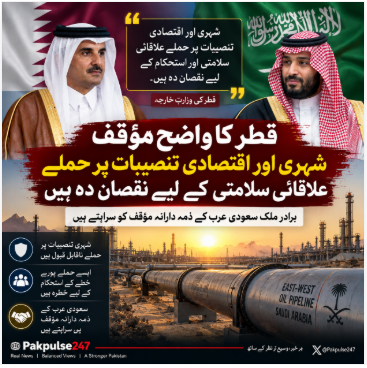
Qatar has strongly condemned attacks targeting civilian and economic facilities in Saudi Arabia, warning that such actions could pose a serious threat to regional security, stability and the wider energy system.
In its latest statement, Qatar’s Ministry of Foreign Affairs expressed serious concern over drone attacks targeting Saudi Arabia’s East-West Oil Pipeline, a strategically important route that carries crude oil from the Kingdom’s eastern producing regions toward the Red Sea.
Qatar said attacks on civilian and economic infrastructure are unacceptable and represent a violation of international law, warning that such incidents could further destabilize an already tense Middle East.
Qatar Praises Saudi Arabia’s Response
The Qatari statement particularly praised Saudi Arabia’s approach to handling the situation responsibly instead of immediately resorting to a broader military response.
Doha welcomed Riyadh’s efforts to address the issue through diplomatic engagement and communication with Iraq.
According to Qatar, Saudi Arabia’s decision to give the Iraqi government an opportunity to ensure that its territory is not used for attacks against neighbouring countries reflects a responsible approach to regional security.
The statement comes at a time when Saudi Arabia is facing growing threats to critical energy infrastructure, including missile and drone attacks linked to Yemen’s Houthi movement as well as security challenges emerging from other directions.
Why Saudi Arabia’s East-West Pipeline Matters
Saudi Arabia’s East-West Pipeline has become increasingly important amid the latest regional tensions.
The pipeline transports crude oil from eastern Saudi Arabia to facilities on the Red Sea coast, providing the Kingdom with an alternative export route if shipping through the Strait of Hormuz is disrupted.
The Strait of Hormuz is already one of the most sensitive points for global energy markets, while Houthi activity around Yemen, the Red Sea and Bab al-Mandeb has placed additional pressure on alternative maritime routes.
Under these circumstances, an attack on the East-West Pipeline is not simply a domestic Saudi security issue.
Any serious disruption could have wider implications for global oil supplies, shipping routes and international trade.
Two Major Maritime Chokepoints Under Pressure
The Strait of Hormuz and Bab al-Mandeb have both become key areas of concern during the current Middle East crisis.
A significant share of oil exported from the Gulf passes through the Strait of Hormuz, while Bab al-Mandeb is crucial for vessels travelling between the Indian Ocean, Red Sea, Suez Canal and Mediterranean.
Growing Houthi activity in Yemen and the Red Sea has increased concerns over Saudi Arabia’s western export routes and the security of commercial shipping.
As a result, attacks on energy infrastructure are increasingly being viewed not only as security incidents but also as potential threats to international energy supplies.
Qatar Expresses Full Solidarity With Saudi Arabia
Doha has made clear that it stands with Saudi Arabia in protecting its sovereignty, security and critical infrastructure.
Qatar also expressed support for measures taken by the Saudi government to safeguard the Kingdom and its strategic facilities.
The statement reflects growing concern among Gulf countries that continued attacks on civilian, energy and economic infrastructure could expand the existing conflict and draw more countries into the crisis.
Focus on Saudi Arabia’s Restrained Response
One of the most significant aspects of the current situation is Saudi Arabia’s comparatively cautious military approach.
Despite recent attacks, Riyadh has avoided an immediate large-scale response that could further escalate an already volatile regional environment.
Qatar’s description of the Saudi position as “responsible” indicates that Gulf states currently appear focused on containing the crisis rather than allowing it to develop into a broader regional confrontation.
However, continued attacks could place that policy under increasing pressure.
Regional Energy Security Becomes a Major Concern
The impact of the current Middle East crisis is no longer limited to military fronts.
Oil pipelines, refineries, ports, tankers and strategic maritime chokepoints are increasingly becoming part of the wider security equation.
If Saudi Arabia’s critical energy infrastructure, the Strait of Hormuz and Bab al-Mandeb all remain under pressure at the same time, the consequences could extend to global oil prices, shipping costs and international trade.
Qatar’s latest statement highlights that broader risk: an attack on the economic infrastructure of one country can quickly become a threat to regional stability and the wider global energy system.