
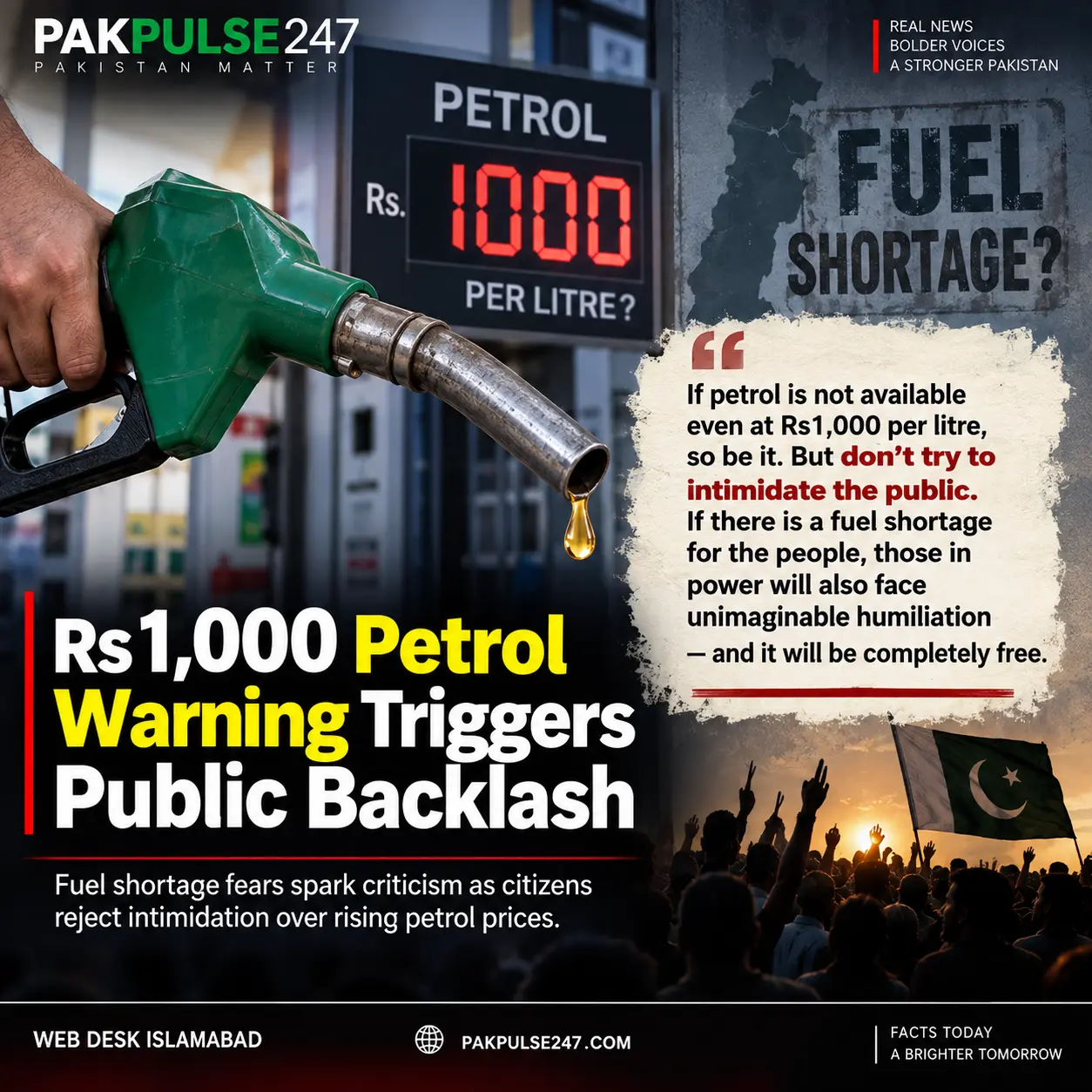
A warning that petrol could become unavailable even at Rs1,000 per litre if Pakistan faces a serious fuel shortage has triggered a fresh political and public debate over rising energy costs, petroleum taxes and the privileges enjoyed by those in power.
Federal Petroleum Minister Ali Pervaiz Malik said the government’s immediate priority was to maintain an uninterrupted supply of petroleum products as international oil markets remain under pressure. He warned that a severe shortage could create a situation in which petrol might not be available even at Rs1,000 per litre.
The remarks quickly became a major talking point, with critics arguing that ordinary citizens should not be frightened with predictions of extreme fuel prices while government expenditures and official privileges remain under scrutiny.
A sharp response circulating in the political debate summed up the anger in unusually direct terms: even if petrol becomes unavailable at Rs1,000 a litre, the public should not be intimidated. If ordinary Pakistanis are forced to suffer because of a fuel shortage, critics argue, those governing the country will also face growing public anger and political pressure.
Fuel Prices Become Major Political Issue
Petrol prices have emerged as one of Pakistan’s most politically sensitive economic issues because changes at the pump quickly affect transport fares, food prices, business costs and household budgets.
The controversy has also intensified amid Jamaat-e-Islami’s nationwide campaign against the petroleum levy.
JI chief Hafiz Naeemur Rehman has repeatedly demanded the complete removal of the levy, arguing that the government should reduce its own expenditure rather than continue placing additional financial pressure on consumers.
The party has now begun its long march towards Islamabad as part of its campaign over petroleum prices, taxation and the cost of living.
Government Focuses on Preventing Fuel Shortage
The Petroleum Ministry maintains that securing sufficient supplies remains the priority as global energy markets face uncertainty.
According to the petroleum minister, authorities are working through different supply channels to ensure that Pakistan has adequate fuel stocks for the coming weeks and months.
The government has also introduced targeted fuel relief for motorcycles, rickshaws, three-wheelers and smaller vehicles, presenting the measure as support for households most affected by higher petrol prices.
Critics, however, continue to demand broader structural relief rather than limited subsidies.
Debate Shifts From Price to Availability
The latest controversy represents a significant shift in the fuel debate.
Until recently, political arguments were largely centred on how much petrol should cost and how much tax or petroleum levy should be charged on each litre. The latest warning has brought another concern to the forefront: whether adequate petrol supplies can be maintained if disruption in international markets becomes more severe.
For millions of Pakistanis who rely on motorcycles, public transport and small vehicles for their daily commute and livelihoods, both price and availability have now become major concerns.
With opposition groups increasing pressure over petroleum taxation and the government warning of serious international supply risks, Pakistan’s fuel crisis is likely to remain at the centre of the economic and political debate in the days ahead.