
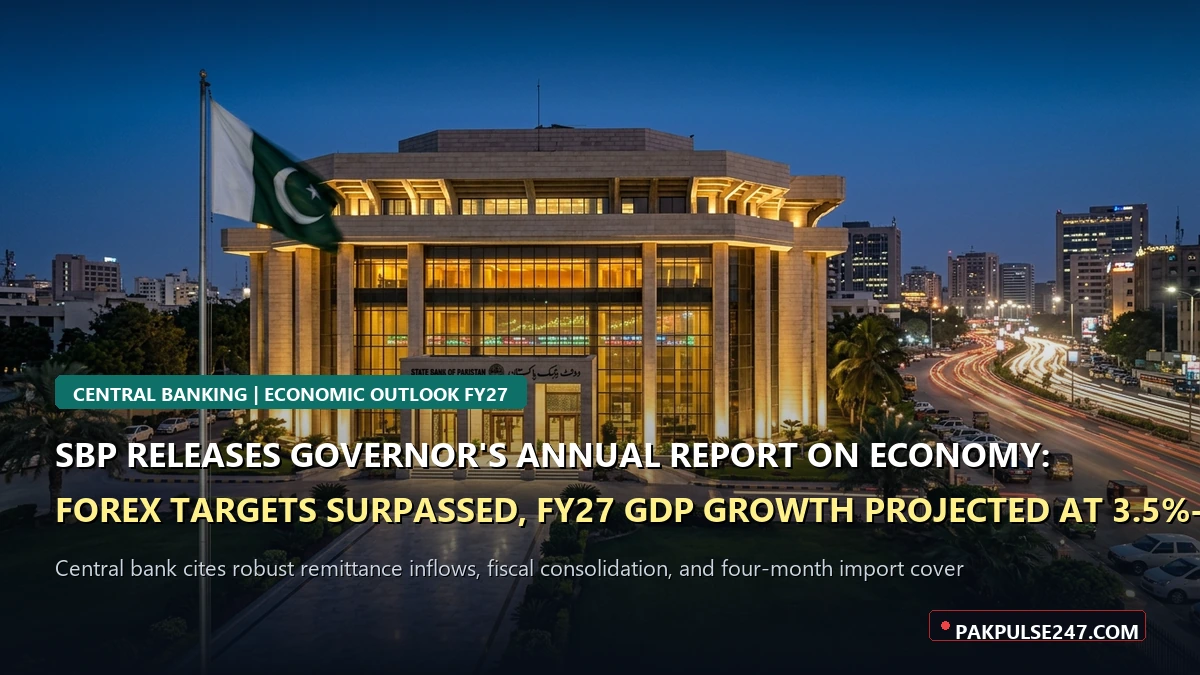
KARACHI: The State Bank of Pakistan (SBP) has formally released the Governor's Annual Report on the State of the Economy for the fiscal year 2025–26, presenting an exhaustive evaluation of Pakistan’s macroeconomic consolidation alongside optimistic growth trajectories for the upcoming fiscal cycle. Formally submitted to the Federal Parliament, the central bank report reveals that Pakistan successfully surpassed its external liquidity benchmarks and projects real GDP growth to rebound into the range of 3.5 percent to 4.5 percent in FY27.
Foreign Exchange Buffers Exceed Projected Targets
A primary highlight of the central bank's annual evaluation is the sustained replenishment of official foreign exchange reserves. Driven by disciplined central bank FX market operations, timely inflows from multilateral and bilateral partners, the resumption of capital market instruments, and robust remittances channeled through the banking system, external buffers exceeded initial targets, extending Pakistan’s import cover to approximately four months.
Current Account Deficit Contained Below 1% of GDP
The report underscores that Pakistan maintained unprecedented external balance stability during FY26, with the current account deficit contained at a modest 0.1 percent of GDP. For FY27, the central bank forecasts the current account gap to remain tightly regulated between 0.0 percent and 1.0 percent of GDP. The SBP highlighted that resilient worker remittances and steady export receipts provided an indispensable shield against volatile global commodity prices.
Inflation Glidepath and Forward-Looking Monetary Stance
Addressing price stability, the SBP reaffirmed that its forward-looking monetary stance—maintaining positive real policy interest rates—successfully anchored inflation expectations amidst brief global energy price spikes. The central bank anticipates headline inflation to progressively decelerate toward its medium-term target band of 5 percent to 7 percent across FY27, fostering an enabling macroeconomic climate for private capital investment.
Structural Reforms and Sustainable Growth Imperatives
While lauding macroeconomic stabilization under strict fiscal consolidation, the central bank issued critical reminders regarding deep-seated structural challenges. The report called for accelerated energy sector rationalization, expansion of the formal tax base, labor productivity enhancements, and proactive investments in climate resilience to protect agricultural output against climatic disruptions. For comprehensive financial data, market analysis, and central banking updates, visit the Pak Pulse 247 News Desk.