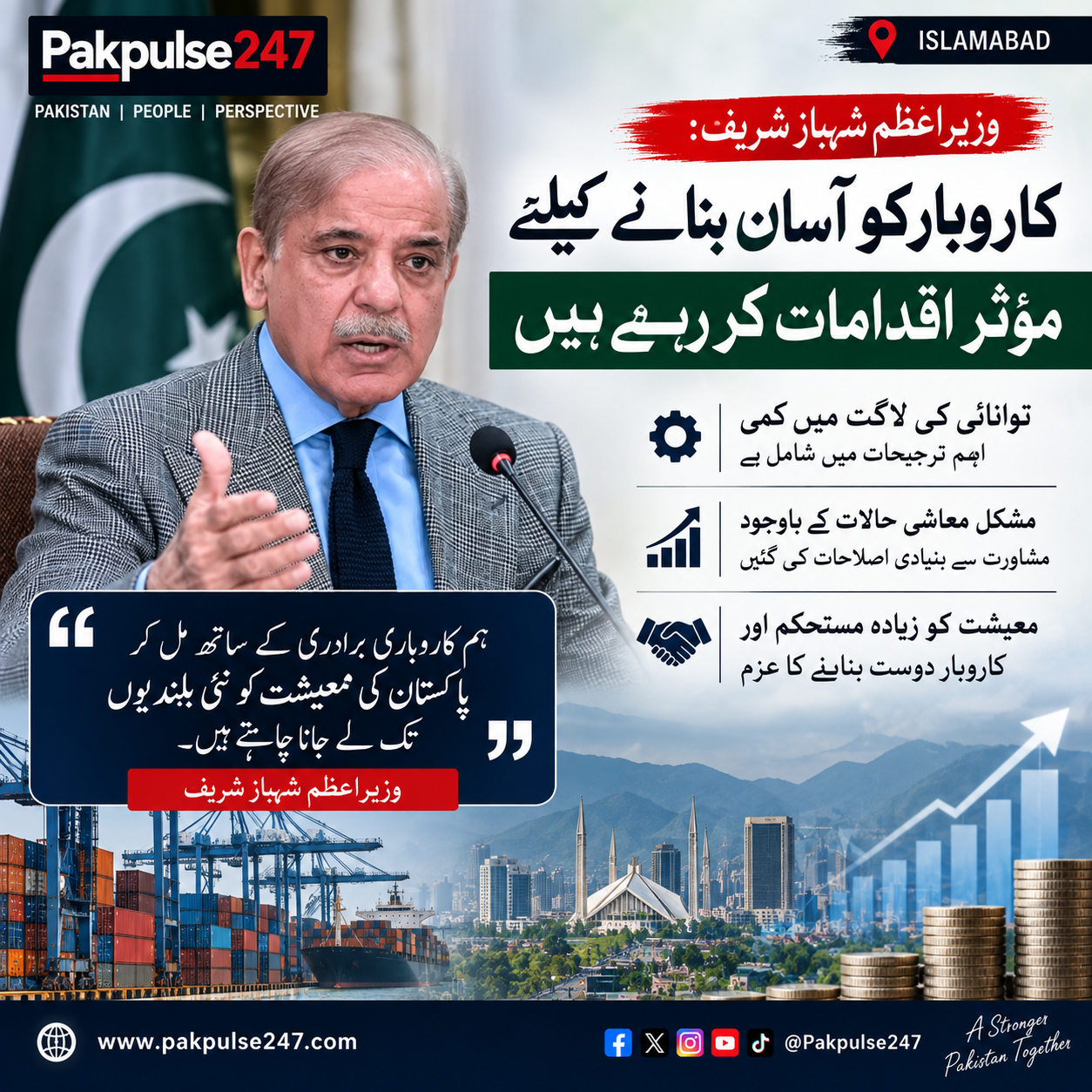
Prime Minister Shehbaz Sharif has said the government is accelerating measures to make doing business easier in Pakistan, with reducing energy costs, cutting unnecessary regulations and expanding exports among its key economic priorities.
Speaking during consultations with leading businessmen and industrialists in Islamabad, the prime minister said Pakistan had gone through difficult economic conditions but several fundamental reforms had been undertaken through dialogue with the private sector.
His remarks come as the business community’s focus increasingly shifts from macroeconomic stabilisation towards the cost of electricity, taxation, regulatory hurdles and whether recent reforms can translate into stronger investment and export growth.
Export-Led Growth Becomes Government’s Main Economic Message
Shehbaz Sharif told business leaders that Pakistan’s future growth would have to be driven by exports, saying meaningful economic expansion could not be sustained without increasing the country’s ability to sell goods and services abroad. (Dawn)
The government has recently intensified consultations with industrialists and exporters on obstacles affecting competitiveness.
The prime minister also directed authorities to examine the possibility of extending super tax relief to exporters, while promising continued engagement with businesses on taxation, trade and investment issues. (Dawn)
The export-focused message has become particularly prominent this week. Business leaders have been discussing not only traditional industries but also telecommunications, digital infrastructure, data centres and artificial intelligence as potential sources of future export earnings. (Dawn)
Energy Costs Remain a Major Concern for Businesses
One of the clearest points in the prime minister’s remarks was that reducing energy costs remains a government priority.
High electricity prices have long been cited by Pakistani manufacturers and exporters as a major barrier to competitiveness, particularly for energy-intensive industries.
The issue is again under scrutiny after recent electricity tariff adjustments. Nepra notified additional fuel and quarterly tariff adjustments affecting consumers, adding to concerns about the cost of power for households and businesses. (Dawn)
The Pakistan Business Forum has also warned that electricity costs and prolonged outages are affecting industrial activity and export orders, keeping energy firmly at the centre of the business community’s economic debate. (Profit by Pakistan Today)
For manufacturers, therefore, the impact of the government’s economic reforms may ultimately be judged not only by broader economic indicators but by whether electricity becomes cheaper and more reliable.
Government Moves to Cut Regulatory Burden
Another major part of the government’s business reform agenda is the removal of unnecessary regulations.
Shehbaz Sharif said work is continuing on a “regulatory guillotine”, a process designed to eliminate outdated requirements, simplify rules and reduce the compliance burden on companies. (Dawn)
Earlier government briefings said work had been completed on 558 proposed reforms aimed at reducing paperwork, regulatory requirements and approval procedures. Of these, 71 measures had already been implemented while another 272 were progressing through different stages. (Radio Pakistan)
Officials estimate that these reforms could eventually save businesses hundreds of billions of rupees in compliance-related costs.
The government has also established a Trade Facilitation Board, headed by the prime minister, to deal with non-tariff barriers and improve cross-border trade procedures. (Dawn)
Rs800 Billion Recovered Without New Taxes, PM Says
During the meeting, Shehbaz Sharif also said the government had recovered around Rs800 billion through enforcement measures during the past year without introducing new taxes. (Dawn)
He presented the figure as evidence that stronger enforcement and administrative reform could improve revenue collection without relying exclusively on additional taxation.
However, businesses continue to seek predictable tax policies and faster resolution of disputes, issues raised during the government’s latest consultations with the private sector.
The prime minister acknowledged that while Pakistan’s macroeconomic position had improved, further work was required at the microeconomic level for the benefits to reach businesses and ordinary citizens. (Dawn)
SMEs Also Being Brought Into Export Strategy
The government is simultaneously attempting to bring more small and medium-sized businesses into Pakistan’s export economy.
A Rs3 billion export insurance risk pool has recently been introduced through the Export Development Fund and EXIM Bank to expand export credit insurance, particularly for SMEs. (Radio Pakistan)
Officials believe improved insurance and financing access could allow smaller firms to enter overseas markets without carrying the same level of financial risk.
The Export Development Fund has also allocated its available Rs24 billion towards programmes aimed at supporting exporters, competitiveness, research and skills development. (Dawn)
Businesses Now Looking for Results on the Ground
The latest discussion reflects a broader change in Pakistan’s economic conversation.
After months dominated by foreign exchange reserves, IMF targets and macroeconomic stability, attention among businesses is increasingly moving towards practical issues: electricity prices, export competitiveness, tax predictability, financing, regulatory approvals and the actual cost of running a company in Pakistan.
That means the next phase will largely depend on implementation.
For exporters and investors, the real test will be whether regulatory reforms shorten approval times, whether the power-sector restructuring produces lower costs and whether government consultations result in measurable improvements for businesses.
Shehbaz Sharif has indicated that consultations with the private sector will continue as the government pursues what it describes as an export-led and business-friendly economic model.
FAQs
What did Shehbaz Sharif say about the cost of energy?
The prime minister said reducing energy costs remains among the government’s priorities as part of efforts to improve Pakistan’s business environment. (Dawn)
What is Pakistan’s current economic growth strategy?
The government is increasingly emphasising export-led growth, with a focus on improving trade facilitation, supporting exporters and reducing regulatory barriers. (Radio Pakistan)
What is the regulatory guillotine?
It is a reform programme aimed at identifying and removing unnecessary regulations, paperwork and approval requirements that increase the cost and complexity of doing business. (Dawn)
What support is being offered to small exporters?
A Rs3 billion risk pool has been established to broaden export credit insurance coverage, particularly for SMEs. (Radio Pakistan)
Why are energy prices important for Pakistan’s exporters?
Electricity represents a significant production cost for many industries, and business groups say high tariffs and unreliable supply can reduce the competitiveness of Pakistani products in international markets. (Profit by Pakistan Today)