
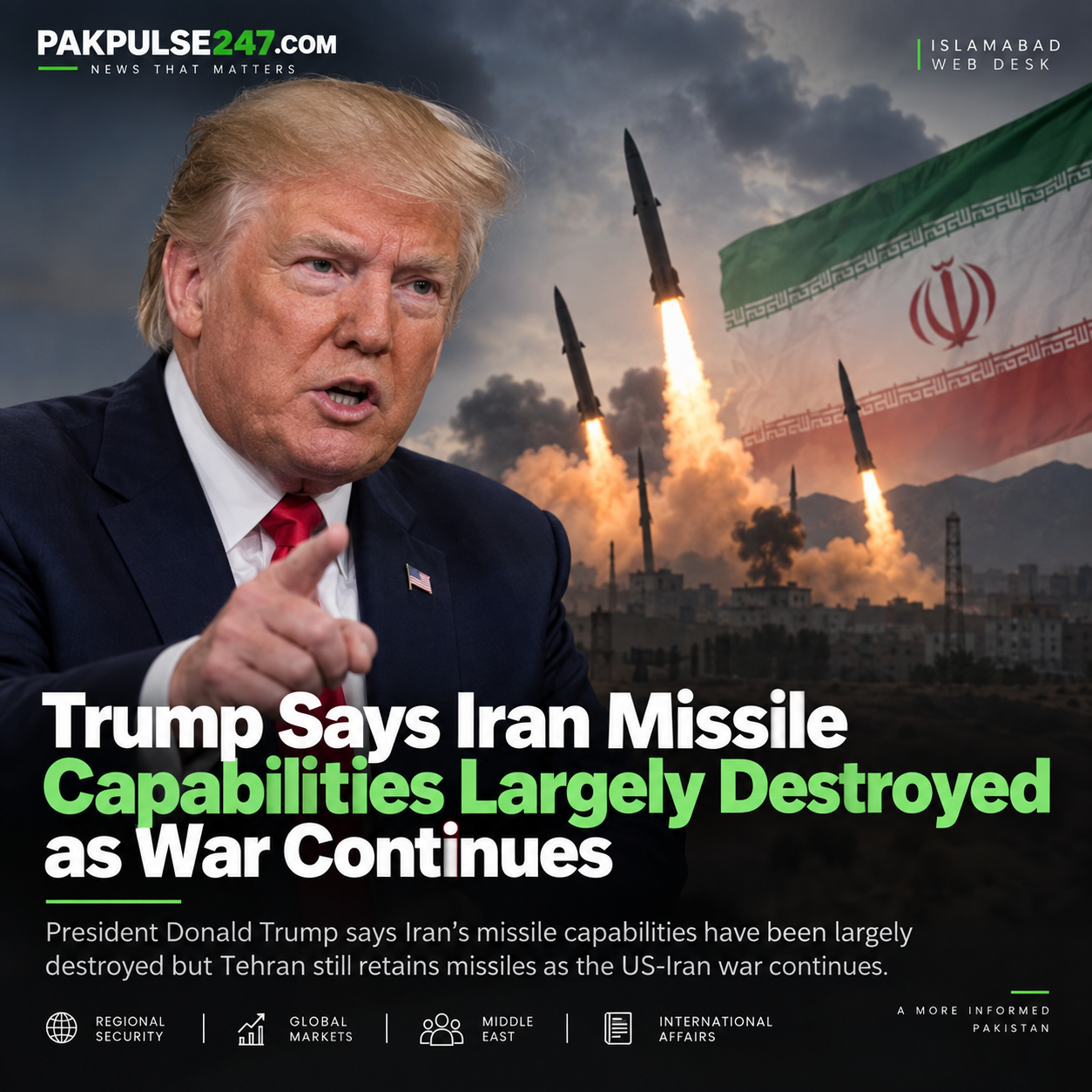
US President Donald Trump has claimed that Iran’s missile capabilities have been largely destroyed, although he acknowledged that Tehran still possesses enough missiles to continue launching attacks as the prolonged US-Iran conflict shows little sign of an immediate end.
Speaking during an interview with American media, Trump described Iran as being under severe pressure after months of military confrontation and repeated strikes on its strategic infrastructure.
Asked how Iran was still able to fire missiles despite damage inflicted during the war, Trump said the country entered the conflict with a substantial missile stockpile and continues to retain some of those weapons.
“They had plenty, and they have some,” Trump said, before claiming that much of Iran’s missile capability had been wiped out. He added that Iran would nevertheless continue to possess at least some missiles.
Trump Says Iran Is in ‘Deep Trouble’
Trump also painted a bleak picture of Iran’s position in the conflict, saying Tehran was “limping along” and facing serious difficulties.
His comments come at a particularly sensitive stage of the US-Iran war, with missile attacks, naval confrontations and pressure around the Strait of Hormuz keeping the Middle East on edge.
Despite repeated US strikes against Iranian military and economic targets, Tehran has demonstrated in recent days that it retains the ability to launch ballistic missiles and threaten American and regional targets.
That continuing capability has become an important question surrounding the conflict: how much of Iran’s missile infrastructure has actually been destroyed, and how long can Tehran maintain its remaining arsenal?
Trump’s assessment represents the US president’s view of the damage inflicted on Iran. The continued use of missiles by Iranian forces indicates that Tehran retains at least part of its operational strike capability.
Iran War Remains a Major Issue for Trump
The interview also highlighted the growing political pressure surrounding the war inside the United States.
Trump defended his decision to enter the conflict and said he would make the same decision again if given another opportunity. He has repeatedly argued that preventing Iran from developing a nuclear weapon remains one of the central objectives of his policy.
At the same time, the president suggested that the conflict could end around the upcoming US midterm elections, while maintaining that Iran is currently under intense military and economic pressure.
The war has become increasingly important in American politics as its economic consequences reach beyond the battlefield.
Strait of Hormuz and Oil Prices Keep Pressure on Global Markets
One of the biggest concerns remains the Strait of Hormuz, where continued confrontation has disrupted shipping and pushed international oil prices higher.
The waterway is one of the world’s most important energy routes, and any prolonged disruption can rapidly affect fuel prices across importing countries.
Pakistan is already feeling the impact of volatility in international oil markets. Petroleum prices have been adjusted repeatedly as instability in the Middle East continues to affect global energy costs.
The conflict is therefore no longer being watched solely as a military confrontation between Washington and Tehran. Its impact is increasingly being felt through oil prices, shipping routes, inflation and financial markets across the region.
Iran Retains Missile Threat Despite Heavy Damage
Trump’s latest remarks underline a central contradiction in the current phase of the war.
Washington argues that Iranian military capabilities have been severely degraded, while Iran continues to demonstrate that it can launch missiles and maintain pressure on US forces and regional targets.
The question now is whether Iran’s remaining missile arsenal can sustain a prolonged confrontation or whether continued US pressure will gradually reduce Tehran’s ability to respond.
For the moment, despite Trump’s claim that much of Iran’s missile capability has been destroyed, the continuing launches show that the missile threat has not disappeared — keeping the region vulnerable to further escalation.